A website sitemap lists all the pages accessible on a domain, organized by categories or hierarchy. On a local media outlet like Le Petit Monégasque, this technical page serves a specific practical function: it displays all the sections and articles published, allowing users to find content without going through the internal search engine or navigating from menu to menu.
Elevation, neighborhoods, and vertical mobility: the Monegasque context complicating information search
Monaco has several overlapping neighborhoods on steep terrain. Traveling between Monte-Carlo, La Condamine, Fontvieille, or the Rock involves public elevators, walkways, and escalators, the existence of which often escapes both visitors and recent residents.
This geographical complexity is reflected in the local informational density. Between the administrative services of the Principality, cultural events at the Grimaldi Forum, exhibitions at the Oceanographic Museum, and news from the Monegasque government, the topics covered by local media are numerous and very varied.
Searching for a specific article on housing, security, or recruitment in Monaco without a structural reference is like navigating a vertical city without knowing the location of public lifts. This is where a complete hierarchy becomes a reliable shortcut: by browsing the sitemap of Le Petit Monégasque, each section appears with its subcategories, reducing the search time to just a few seconds.

Structure of an editorial sitemap: sections, categories, and thematic navigation
An editorial sitemap differs from an XML sitemap intended for search engines. The former is designed for human users, while the latter is for indexing bots. On a media outlet like Le Petit Monégasque, the viewable version displays sections such as justice, public services management, cultural publications, or practical information about the Mediterranean.
The organization generally follows a thematic logic rather than a chronological one. Articles on the Monegasque labor code, for example, are found in a distinct category from those dedicated to exhibitions at the Grimaldi Palace or recruitment policies in the Principality.
What this structure concretely changes
Without a sitemap, a reader looking for a file on housing in Monaco must formulate the correct query in the internal search field, hoping that the keywords match the exact title of the article. The sitemap removes this constraint by making the entire hierarchy visible.
Browsing categories allows discovering related content that a targeted search might not have surfaced. A reader interested in recruitment in the Monegasque public service might come across, in the same section, an article discussing residency conditions or nationality law.
Concrete use cases: when the sitemap replaces keyword search
Keyword search works well when the reader knows exactly what they are looking for. It shows its limits in three common situations.
- The reader explores a broad topic (daily life in the Principality, administrative procedures, security) without a specific term in mind. The sitemap offers them a panoramic view of the available content.
- The reader returns to the site after several weeks and searches for an article read previously, of which they have forgotten the exact title. Browsing the relevant category is often enough to find it.
- The reader compares several articles on the same theme (for example, publications related to the Monegasque government or events linked to Louis II) and needs to identify them quickly in a structured list.
In each of these cases, the sitemap acts like a table of contents rather than an alphabetical index. The difference is notable: the table of contents shows the logical progression, while the index only shows isolated entries.
Digital orientation tools in Monaco: from sitemap to city map
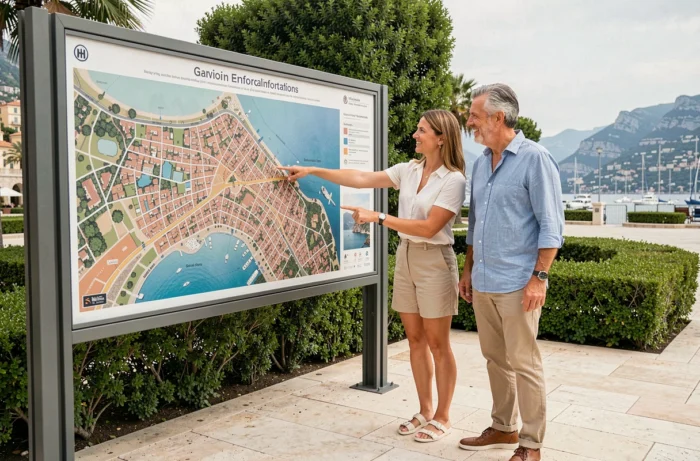
The Principality has been developing digital tools for several years to facilitate physical orientation in the city. The platform Your Monaco offers interactive urban information covering transportation, pedestrian routes, and nearby services.
Recent guides detail the combined use of several types of maps to compare public transport, parking, electric vehicle charging stations, and pedestrian links. This multi-modal approach goes beyond a simple tourist map and reflects a growing need for structured plans based on use cases.
The parallel with web navigation
The same principle applies to navigating a local information site. A well-constructed sitemap categorizes content thematically (culture, civil status, exhibitions, justice, Mediterranean) just as a city map categorizes places by function (administration, leisure, transport).
A structured sitemap by categories reduces search time just like a pedestrian map indicating public elevators reduces travel time in a hilly city. The logic is the same: making visible what exists but remains hidden without an overview.
- City maps show public lifts and walkways that pedestrians cannot see from the street.
- Sitemaps show sections and subcategories that readers cannot see from the homepage.
- In both cases, the tool transforms random exploration into an oriented journey.
A local information site inherently covers very different topics, from recruitment in the Principality to exhibitions at the Oceanographic Museum, including the management of legal affairs or official publications. Without a visible hierarchy, this richness remains fragmented. The sitemap is the only place where it appears as a whole, organized and accessible in just a few clicks.