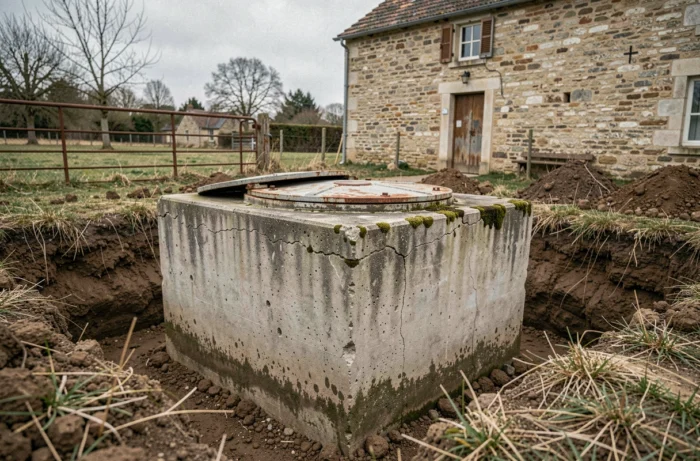
On the ground, we regularly come across septic tanks installed in the 1960s, the exact layout of which is unknown. No plan in the municipal archives, no visible inspection chamber on the surface, and a fibrocement pipe running under the lawn with no idea where it leads. Understanding the layout of a septic tank from that era is the first step before any intervention, whether it be a pumping, a SPANC diagnosis, or a compliance project.
Materials and Design of 1960s Septic Tanks
Septic tanks from this period do not resemble the polyethylene tanks that are installed today. They mainly consist of masonry structures made of concrete blocks, sometimes with concrete poured on-site, featuring an internal waterproofing layer that has often deteriorated. Some installations use stacked concrete pipes.
The recurring problem is porosity. After more than sixty years, the joints between concrete blocks allow wastewater to seep into the soil, which disrupts the system’s operation and contaminates the shallow aquifers. When conducting a survey around the tank, saturated soil areas that have nothing to do with the intended drainage are frequently identified.
The geometry also differs from modern tanks. In these older installations, the tank is often rectangular, sometimes divided into two compartments by a siphon wall made of concrete. The depth varies greatly depending on the terrain and the mason’s practices of the time. To find the layout of a 1960 septic tank when no documents exist, soil probing and camera inspection of the pipes are carried out.
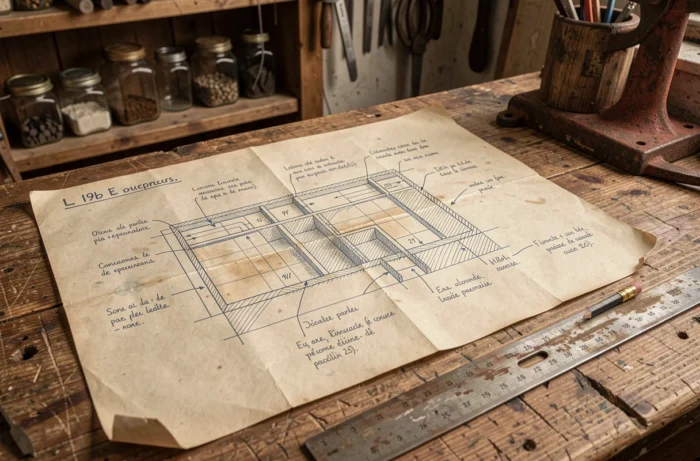
Water Circuit in a 1960s Septic Tank
The fundamental point to remember: an old septic tank only treats black water, meaning only the water from toilets. Household water (kitchen, bathroom, washing machine) went into a separate network, often leading to a soakaway or directly into a ditch.
The flow of black water follows a simple path:
- Water enters through an inlet pipe, usually made of fibrocement or sandstone, with a slight slope towards the tank.
- In the first compartment, solid materials settle at the bottom as sludge. Fats and light materials rise to the surface to form a crust.
- The siphon wall (when it exists) allows intermediate water to pass into a second compartment, where sedimentation continues.
- Clarified water exits through an outlet pipe, directed towards an underground drainage system or, in many cases, towards a non-compliant surface outlet.
Anaerobic fermentation occurs naturally in the tank: bacteria break down some of the organic materials in the absence of oxygen. This process generates gases (methane, hydrogen sulfide) that must be vented. In 1960s installations, ventilation is often absent or blocked, leading to odors and accelerating the corrosion of concrete.
SPANC Diagnosis and Old Tanks: What Has Changed Recently
Since 2009, the installation of septic tanks (only black water) is no longer allowed for new constructions. Only all-water tanks, which collect all domestic wastewater, comply with regulations.
For owners of older homes, the situation becomes more complicated. The SPANC (Public Service for Non-Collective Sanitation) conducts periodic inspections, and the trend since 2024 clearly leans towards tightening the frequency. Several municipalities have reduced the inspection cycle, sometimes from eight years to four years in sensitive areas. The national maximum frequency is tending to approach six years for functionality checks, where the ten-year ceiling had long been the reference.
In the event of a sale, a sanitation diagnosis of less than three years is mandatory. If the installation is declared non-compliant, the buyer has one year after signing to carry out the necessary upgrades. The cost and complexity depend on the terrain, accessibility, and the type of system chosen (all-water tank with drainage, micro-station, compact filter).
Preliminary Soil Study: An Often Ignored Requirement
Before any replacement, a soil study (parcel study) is required to determine the permeability of the land and correctly size the sanitation system. On clayey soils, common in certain regions, traditional drainage is sometimes impossible, which leads to compact solutions like a micro-treatment plant.
Feedback varies on this point, but it is observed that soil studies conducted afterward regularly reveal incompatibilities with the old system: the 1960s tank operated on land that should never have received drainage.
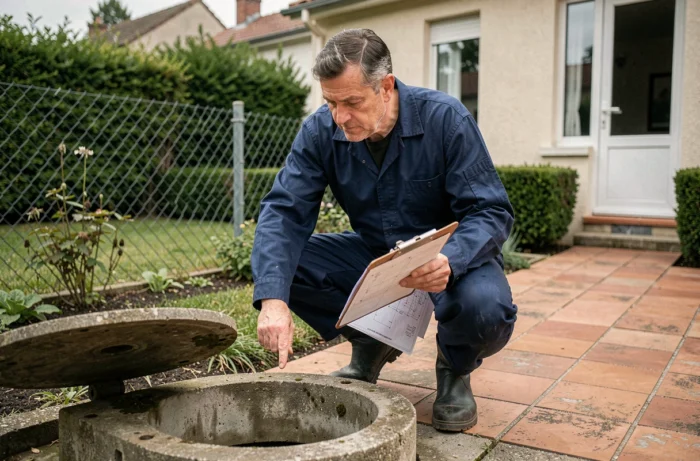
Maintenance and Warning Signs of an Old Septic Tank
Even if a compliance upgrade is planned in the long term, keeping an old tank operational is necessary to avoid backflows and soil pollution.
Pumping should occur when the sludge reaches about half the volume of the tank. In a small-capacity 1960s installation, this can happen more often than one might think. Never pour excess bleach, solvents, or wipes into the system: these products destroy the bacteria responsible for fermentation and clog the pipes.
Several signs should raise alarms:
- Persistent odors around the tank or in the house, indicating a ventilation failure or a saturated tank.
- Backflows in toilets or low pipes.
- Abnormally green or dense vegetation above the drainage area, indicating a rise of effluents.
- Standing water on the surface at the drainage field.
When these symptoms are spotted on a tank over sixty years old, the question is generally no longer about repairing but about planning the replacement with a system compliant with current non-collective sanitation regulations.