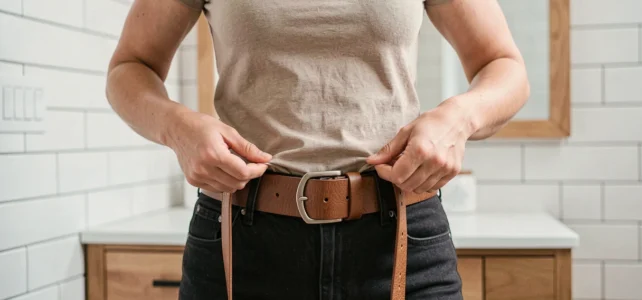
A full-grain leather belt that slips out of the loop after a few hours is a problem of friction and tension, not fashion. The strap lacks grip on the prong or the retention mechanism, and the weight of the free end exacerbates the gradual loosening. Understanding this mechanism allows for the right correction to be chosen rather than piling on makeshift solutions.
Belt Profile and Friction Coefficient: Why Some Belts Slip
Slippage depends on three parameters: the thickness of the strap, the type of finish on the flesh side, and the geometry of the buckle. A smooth chrome leather with a surface varnish offers very little resistance when passing through the prong. The free end retracts under its own weight as soon as the posture changes.
Grain leather, nubuck, or suede belts have a natural roughness that slows down the strap. In contrast, glossy or varnished finishes reduce friction to the point where even a properly positioned hole is not enough to maintain tension.
We recommend examining the buckle itself. A prong buckle without a retention bar allows the strap to slide back freely. Buckles with a fixed bar or an internal locking notch maintain position without relying solely on the hole. This is the first criterion to check before any other trick.
To hold up a drooping belt without a hole, you must first identify whether the problem comes from the strap, the buckle, or the excess length, as each cause requires a different solution.
Automatic Notch Belt: The Mechanism That Eliminates Length Issues
Ratchet systems use a rack integrated into the strap, combined with a locking mechanism in the buckle. The strap is cut to the exact length, and the tightening adjusts in increments of a few millimeters.
The free end never exceeds the first loop since the strap is custom cut. This point simultaneously resolves slippage and the excess that droops.
We have observed that this type of closure has seen a significant increase in demand in recent months, driven by uses where a flat profile under clothing is paramount: travel with security checks, office attire, wearing under a blazer. The rack fits within the thickness of the leather without adding visible bulk.
Criteria for Selecting a Good Ratchet Mechanism
- The rack should be made of stainless steel or nickel-plated zamak to resist corrosion. ABS plastic versions break after a few months of daily use.
- The unlocking lever should be operable with one hand, without tools. A mechanism that is too rigid ends up being abandoned.
- The strap must be cuttable with a cutter without fraying, which implies leather glued to a textile reinforcement or high-density reconstituted leather.
- The standard width of 35 mm fits most dress pant loops. For jeans, plan for 38 to 40 mm.
Tip for Adding an Elastic Loop to a Classic Prong Belt
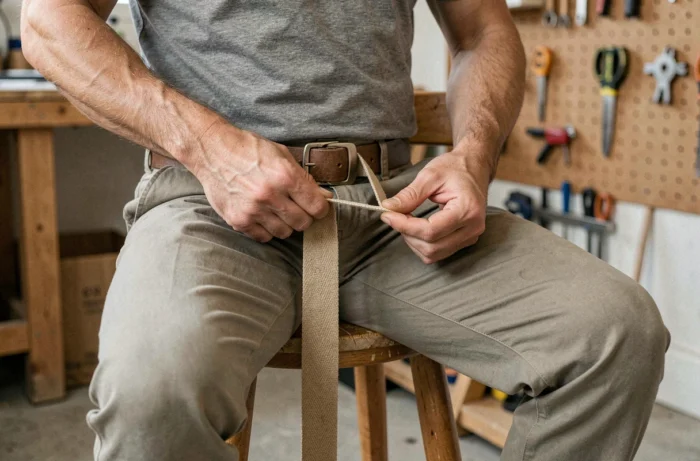
When keeping a traditional belt, the free end that extends beyond the first loop poses a double problem: it is visible under a fitted sweater, and its weight pulls the buckle down.
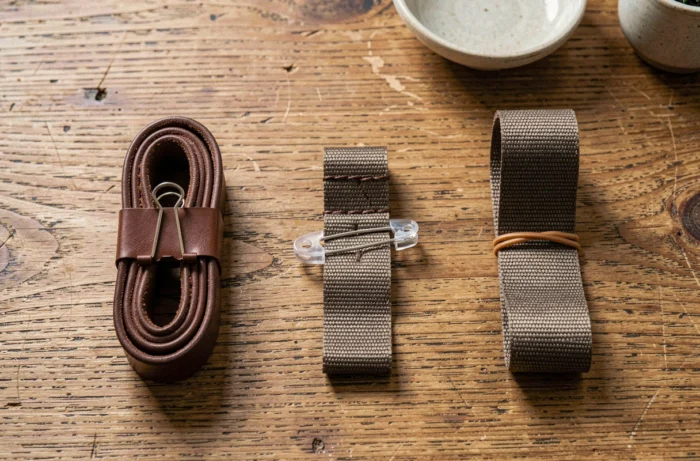
The cleanest solution is to add a silicone or soft leather elastic loop. These loops slide onto the strap before buckling and position just after the first sewn loop. They hold the free end against the body without altering the belt.
Installation and Positioning
The added loop is placed between the first and second loops of the pants. If it is too far from the buckle, it does not exert enough pressure. If too close, it obstructs the prong.
Transparent silicone versions visually disappear on light leather. For black leather, a matching leather loop hand-stitched offers a more discreet look than a textile elastic.
Woven Elastic Belt: Continuous Adjustment Without Holes or Excess
Woven elastic belts operate on a different principle. The prong inserts between the weaves of the braid at any point along the strap. Each gap in the braid acts as a hole, allowing for nearly millimeter-perfect adjustment.
This type of belt does not slip because the braid exerts a slight elastic tightening pressure around the waist, independent of the prong. The free end remains short since you buckle exactly at the comfort point.
We recommend polyester-elastomer blends for the braids rather than pure cotton. Cotton deforms after a few months and loses its elastic recovery capacity. Woven polyester maintains its tension for several years.
Limitations to Know
The woven elastic belt does not work well with formal attire. Its texture and variable thickness make it visible under a tucked-in shirt with dress pants. However, it is perfectly suited for chinos, jeans, or worn over a dress.
Reducing the Length of a Leather Belt Without Destroying It
For a leather belt with excess length exceeding fifteen centimeters after the first loop, cutting remains the cleanest solution. The method depends on the type of buckle attachment:
- Screwed buckle: remove the screws, cut the strap on the buckle side (not the free end), reposition the buckle, re-drill the screw holes.
- Snap buckle: open the snaps with a flat screwdriver, cut, reattach the snaps with a riveting tool.
- Sewn buckle: unpick, cut, re-sew with saddle stitch using waxed linen thread. A saddle stitch withstands tension where a simple machine stitch gradually unravels.
Cutting on the buckle side and not the free end preserves the original rounding and the edge finish. A coat of beeswax on the cut edge prevents the leather from fraying.
A drooping belt is not a fashion fatality. Between the ratchet mechanism for those who want a definitive solution, the added loop for a quick fix, and the adjusted cut for quality belts that one wants to keep, each approach meets a different degree of demand. The choice is primarily based on the type of buckle and the rigidity of the strap, not on the latest trend seen online.