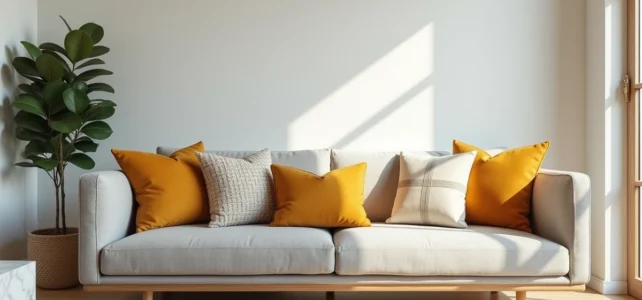
A gray sofa absorbs ambient light and reflects a different tone depending on whether it leans towards pearl, mouse, or anthracite. The cushions you place on it do not just serve to “decorate”: they correct the visual temperature of the room, adjust seating comfort, and guide the overall style of the living room. Understanding these three functions helps avoid classic mistakes that result in a bland or, conversely, overloaded outcome.
Gray Temperature and Chromatic Response of Cushions
You may have noticed that the same yellow cushion looks vibrant on a light gray sofa but almost dull on an anthracite gray one? It’s a matter of value contrast. The darker your gray, the more it “eats” less saturated colors. The lighter it is, the more it amplifies bright shades.
Before thinking about colors, identify the undertone of your gray sofa. A warm gray leans towards beige or taupe. A cool gray leans towards blue or green. This undertone determines the colors that naturally work with it.
For a warm gray, cushions in terracotta, mustard, or old rose tones extend the harmony. For a cool gray, duck blue, sage green, or off-white create a pleasant continuity. Crossing families (warm color on cool gray) also works but requires more mastery in quantities.
If you are looking to choose cushions for a gray sofa based on these chromatic principles, the logic remains the same: start from the sofa, not from the current trend.
Textures and Materials: What Really Changes the Atmosphere of the Living Room
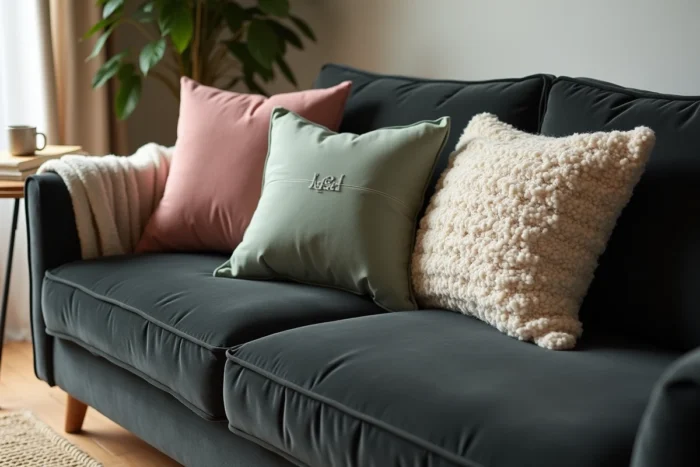
Color catches the eye first, but it is the material that gives the impression to the touch and sight. A corduroy cushion on a patterned fabric sofa does not produce the same effect as a linen cushion on the same sofa.
The Principle of Tactile Contrast
Combining at least two different textures on the same sofa prevents the whole from looking flat. Imagine a gray sofa in boucle fabric: a smooth velvet cushion adds depth, while a washed linen cushion adds relaxation.
Materials also have an effect on the perception of warmth. Velvet and boucle wool visually warm up a room. Linen and washed cotton cool it down. In a north-facing living room with little natural light, prioritize materials that capture light rather than those that absorb it.
Materials to Favor According to the Season
- In autumn and winter, velvet, faux fur, and thick knits provide a visual cocoon without changing the sofa.
- In spring and summer, linen, crinkled cotton, and lightweight weaves lighten the whole and give a sense of freshness.
- All year round, a neutral textured fabric cushion (ecru, mottled gray, off-white) serves as a “binder” between seasonal cushions.
Changing two cushions out of five is enough to transform the atmosphere of a living room without starting from scratch.
Cushion Shapes and Sizes for Gray Sofas: Moving Beyond All Square
The majority of living rooms stack identical square cushions. The result is symmetrical but monotonous. Varying formats creates movement and a more natural look.
A rectangular or lumbar cushion placed in the center or on the armrest breaks the repetition of squares. Cylindrical formats (bolsters) fit particularly well with sofas that have rounded lines, a marked trend in recent furniture with low seats and curved backs.
Be mindful of proportions: on a two-seater sofa, a maximum of three cushions avoids clutter. On a corner sofa, you can go up to five or six, but be sure to leave at least one-third of the seat visible. A sofa buried under cushions loses its visual identity and, above all, its comfort of use.
Ergonomic Cushions on Living Room Sofas: Postural Comfort and Decoration
Cushions are not just for decoration. In recent years, the demand for ergonomic cushions in living spaces has increased. ZenPur, in its guide to cushion trends for the home, describes a shift towards functional and therapeutic design, where sofa cushions are chosen as much for postural support as for aesthetics.
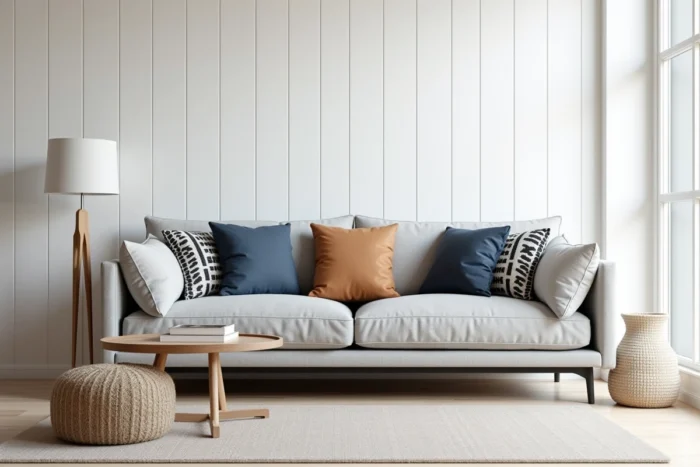
Specifically, a well-densified lumbar cushion placed in the small of the back corrects posture on a deep-seated sofa. A cylindrical neck cushion allows for lying down without cervical tension. These formats now come in colors and materials compatible with a refined decor.
The advantage for a gray sofa: ergonomic cushions in neutral tones (mottled gray, beige, ecru) blend into the whole, while colored models (duck blue, terracotta) play the dual role of support and decorative accent.
Cushion Arrangement on a Gray Sofa: A Concrete Method
Rather than aiming for perfect symmetry, strive for an asymmetrical balance with a focal point. Here’s a simple method, adaptable to most sofas:
- Start with the two corners of the sofa with a large square cushion in a shade close to gray (tonal, one shade lighter or darker).
- Add a smaller cushion in front of each, in a contrasting color or pattern, slightly offset towards the center.
- Place a different format (rectangular, cylindrical) in the center in a textured material that contrasts with the others.
- Step back two meters and check that the eye moves naturally from left to right without dead spots or overload.
This arrangement works well with three cushions on a small sofa as well as with six on a corner model. The principle remains the same: vary size, color, and texture in successive layers.
The last reflex to adopt: test your cushions in evening light, not just in daylight. Artificial lighting significantly alters perceived colors, and a perfect cushion in natural light can appear dull under a cool white bulb. Adapt your choices to the dominant lighting in your living room, the one under which you actually spend your evenings.