
Portable power stations have multiplied in the market over the past few years, driven by various uses: camping, vanlife, off-grid telecommuting, and home backup during outages. Behind often similar technical specifications, the performance and longevity differences between two models can be considerable. Choosing a portable power station suitable for your electrical equipment requires looking beyond just the capacity figures displayed in the showcase.
Battery Cycles and Actual Lifespan of a Portable Power Station
Most comparisons focus on watt-hour capacity and output power. These two data points are useful, but they say nothing about the actual lifespan of the station. The parameter that makes the difference in the long term is the number of charge-discharge cycles the battery can endure before losing a significant portion of its capacity.
Recent stations are massively adopting LiFePO4 (lithium iron phosphate) chemistry, which offers significantly greater longevity than older NMC or NCA lithium cells. For example, Jackery states that its Explorer 2000 Plus station in LiFePO4 is designed to operate for up to 4,000 cycles before capacity drops to 70%. On a conventional lithium-ion station, this threshold is reached much earlier.
For daily or very frequent use (vanlife, mobile worksite), this difference translates to several additional years of service. You will also find information on simplyhabitat.fr detailing selection criteria based on usage profile.
A point rarely addressed: storage conditions also influence longevity. Jackery recommends keeping the station with at least 20% residual charge. Leaving a LiFePO4 battery completely discharged for several weeks accelerates its degradation, even though this chemistry is more tolerant than older generations.
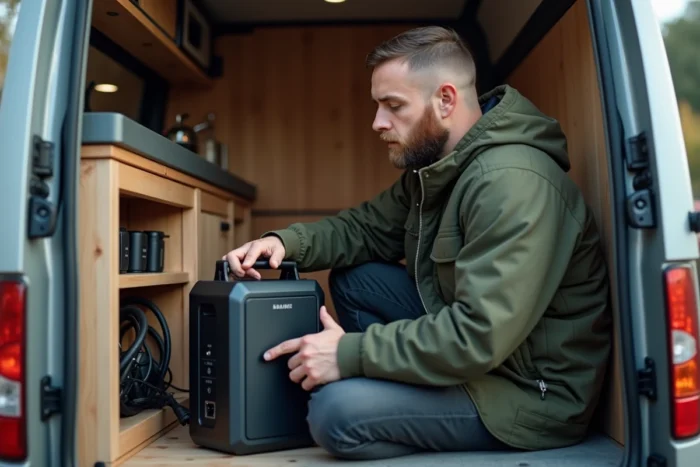
Watt-hour Capacity and Output Power: Two Data Points Not to Confuse
Capacity (expressed in Wh) represents the total energy reserve. Output power (in watts) indicates the maximum instantaneous flow that the station can provide. Confusing the two leads to frequent sizing errors.
A station displaying a large capacity but limited output power will not be able to power a power-hungry device, even if it has enough energy in reserve. Conversely, a powerful station but with low capacity will power a demanding piece of equipment, but for a very short time.
- To recharge phones, laptops, or cameras, a station of a few hundred Wh with moderate power is more than sufficient.
- To power a portable refrigerator, electric tools, or a small space heater, aim for a capacity greater than 1,000 Wh and check that the output power covers the device’s startup peak.
- For mixed use (extended camping, home backup), the output power must cover the startup peak of the largest intended device, not just its nominal consumption.
Some manufacturers like EcoFlow offer software boost technologies (X-Boost) that allow temporarily exceeding the nominal power. Field feedback varies on this point: efficiency depends on the type of device plugged in, and not all equipment reacts the same way to this type of temporary overloading.
Solar Charging of a Portable Station: Promises and Concrete Limits
Compatibility with solar panels has become an almost systematic selling point. In practice, the speed of solar charging depends on several factors that product sheets do not always detail.
Actual sunlight, panel orientation, and ambient temperature significantly alter efficiency. A portable solar panel rated at 200 W will only produce this power under optimal conditions, which are rarely met in a nomadic situation. While camping or in a van, actual production often falls well below the nominal value.
The type of panel also plays a role. Monocrystalline panels offer better efficiency per surface area than polycrystalline or amorphous panels, but their rigidity can pose transportation issues. Foldable panels, which are more convenient to move, sometimes have slightly lower efficiency.
Before investing in a station plus solar panel kit, it is useful to calculate the realistic charging time. Dividing the station’s capacity by the estimated solar production under average conditions gives a more reliable indication than the times announced by manufacturers, which are calculated in a laboratory.
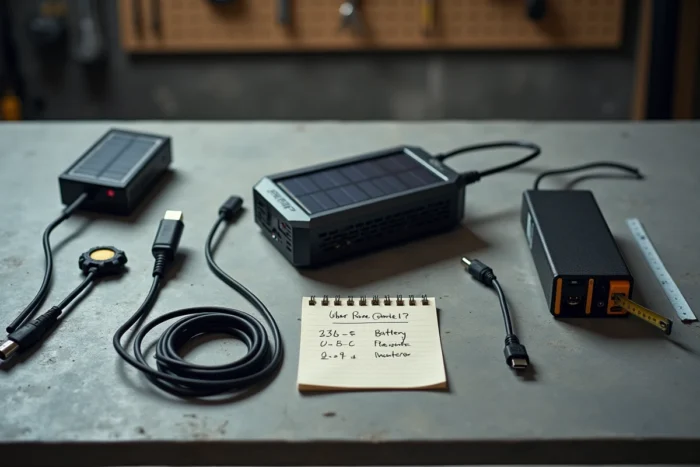
Portable Power Station for Camping: Which Connectors to Check
Beyond capacity and power, the available connectivity determines what the station can actually power. Not all models offer the same outputs, and some camping equipment requires specific connectors.
- AC outlets (220 V) allow you to plug in standard household appliances, but not all stations offer multiple simultaneously.
- USB-A and USB-C ports cover the charging needs of small devices. The presence of a USB-C port with fast charging (Power Delivery) is a real plus for recent laptops.
- DC outputs (12 V) are useful for devices designed for automotive or camper use, such as coolers or certain lights.
- Checking the number of simultaneously usable outputs is as important as checking their type, as some stations limit total power when multiple ports are active at the same time.
Weight also factors into the equation. A high-capacity station can exceed ten kilograms, complicating transport during hiking or lightweight camping. For stationary use (converted van, base camp), weight matters less than the versatility of the outputs.
The market for portable power stations is evolving rapidly, with more durable batteries and more diverse charging options. The most relevant choice remains one that starts from your actual devices, their measured consumption, and how often you plan to use the station. An oversized station is costly and heavy for no reason, while an undersized station will not meet your needs when you need it most.