A child snacking on a cookie in front of a tablet at 4 PM, then having fruit juice at 5 PM, and then a candy at 6 PM: we have just created three distinct acid attacks on the enamel, without giving saliva time to do its remineralization work. Children’s oral health is less about the choice of toothpaste than about these micro-decisions in daily life, often invisible.
Snacking and screens: the duo that accelerates cavities in children
Most content on children’s dental hygiene talks about brushing, fluoride, and dentist visits. The most destructive mechanism in daily life is rarely addressed: the frequency of sugary intakes, not their total amount.
Each time a child consumes a food or drink containing free sugars, the oral pH drops for about thirty minutes. During this window, the enamel demineralizes. If intakes are continuous, the mouth remains in a state of almost permanent acidity.
Grouping sugars at dessert time after meals, rather than spreading them throughout the day, radically changes the situation. This creates real intervals without sugars where saliva can remineralize the teeth. Recent studies identify a marked risk threshold around a few percent of energy intake from free sugars, beyond which the cavity curve increases significantly in vulnerable children. Additional information on pediatric dental prevention is available at https://www.souriresdenfants.be/, which details the appropriate actions for each age group.
The link between screen time and cavities also deserves attention. A recent clinical summary shows a significant association between sugary consumption in front of a screen and carious lesions in children. The problem does not come from the screen itself, but from the automatic snacking it promotes: the child eats without thinking, without a signal to end the meal, and the frequency of intakes skyrockets.

Brushing baby teeth: technique and toothpaste dosage by age
It is often said that teeth should be brushed as soon as the first baby tooth appears. This is true, but the way to do it varies greatly by age, and errors in fluoride toothpaste dosage are common.
Before 3 years: a parental gesture
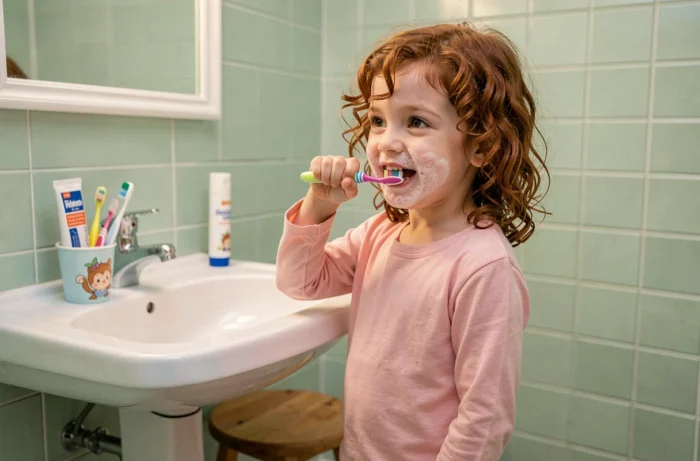
The child cannot spit. A soft-bristled brush with a compact head is used, with a simple smear of fluoride toothpaste (the size of a grain of rice). Brushing is done twice a day, morning and evening. The parent holds the brush.
From 3 to 6 years: mandatory supervision
The child begins to want to brush alone, but their fine motor skills do not allow them to reach the inner surfaces and back molars properly. They are allowed to do a first pass, then the parent brushes all surfaces. The toothpaste dosage increases to the size of a pea.
After 6 years: gradual autonomy
The child can manage their brushing, but the technique should be checked regularly. Two actual minutes (not estimated) remain the target. A timer or hourglass in the bathroom solves the problem better than a verbal instruction.
Points to check regardless of age:
- Brush the outer, inner, and chewing surfaces, not just the visible front of the teeth
- Angle the brush at 45 degrees towards the gum to dislodge plaque at the tooth-gum junction
- Do not rinse abundantly after brushing: spitting out the excess toothpaste without rinsing with a lot of water allows fluoride to stay in contact with the enamel longer
Diet and cavity prevention: what really matters
Reducing sugars is such a repeated piece of advice that it loses its practical usefulness. What matters in the mouth is not just the amount of sugar ingested, but the number of sugary contacts per day and their distribution.
A child who eats three squares of chocolate for dessert generates a single acid attack. The same child who sucks on a candy at 10 AM, drinks a syrup at 3 PM, and snacks on a cake at 5 PM produces three. The second situation is much more damaging to the enamel, even if the total amount of sugar is equivalent.
Some concrete guidelines for daily prevention:
- Water remains the only drink to offer between meals; fruit juices, even without added sugar, contain free sugars and acids
- Cheese at the end of a meal helps raise oral pH thanks to calcium and caseins
- Unsweetened applesauce remains acidic: it is better to integrate it into the meal rather than as an isolated snack
- Pediatric medications in syrup form often contain sugar; brushing after the evening dose is recommended

First visit to the dentist: at what age and why not to wait
It is often expected that a problem will arise (pain, stain on a tooth) before consulting a dentist with a child. This is too late for prevention.
The first dental consultation is recommended around the age of one, or within six months of the eruption of the first baby tooth. This early visit is not technical: the practitioner checks the development of the mouth, identifies potential risk factors (mouth breathing, short tongue tie, sucking habits), and most importantly, familiarizes the child with the dental office environment.
A child who discovers the dental chair in a calm, pain-free context develops a neutral relationship with care. A child who arrives for the first time with a painful cavity associates the dentist with suffering, complicating the entire subsequent care journey.
Feedback varies on the ideal frequency of follow-up, but a check-up every six months to a year remains the most common rhythm for children at moderate cavity risk. The dentist can adjust this frequency according to each child’s profile.
Children’s oral health relies on three pillars that mutually reinforce each other: a controlled frequency of sugars, supervised brushing with the correct fluoride dosage, and early dental follow-up. None of these actions are spectacular, but their regularity makes all the difference in the state of the mouth in adulthood.