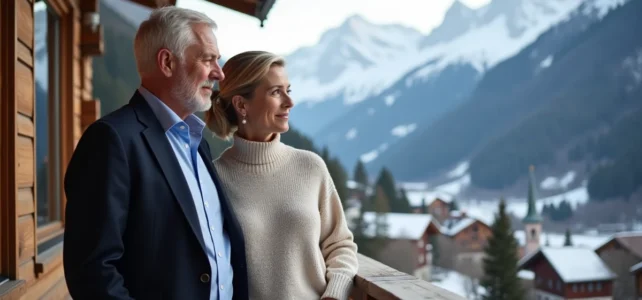
An apartment in the Vaud Alps, a chalet in Verbier, a pied-à-terre near Lake Geneva: owning a second home in Switzerland is no longer just a dream for wealthy retirees. It attracts a diverse range of profiles, including foreign investors looking to protect their capital in a market known for its stability. However, between legal restrictions and ongoing tax reforms, the situation is more nuanced than it seems.
Second homes in Switzerland: a market structurally limited by the Lex Weber
Have you ever noticed that some Swiss resorts seem frozen in time, with very few new constructions? This is no coincidence. Since the implementation of the initiative on second homes (known as Lex Weber), a municipality cannot exceed 20% of secondary housing in its residential stock.
In practice, tourist municipalities that have already reached this threshold no longer issue new building permits for second homes. This cap has created a mechanical scarcity effect on the available supply.
For an investor, this constraint plays a dual role. It limits access to the market, as the stock of eligible properties decreases each year in the most sought-after areas. At the same time, it supports long-term prices, as demand remains strong while supply is constrained. Those considering buying a second home in Switzerland should understand this dynamic before positioning themselves on a property.
Reform of imputed rental value: what changes for the taxation of second homes
Switzerland applies a little-known tax mechanism abroad: the imputed rental value. The principle is simple. If you own a property that you do not occupy permanently, the tax authorities consider that you receive a fictitious income, corresponding to the rent you could derive from this property. This amount is added to your taxable income.
In return, owners can deduct the interest on their mortgage debt and maintenance costs of the property. This system made owning a second home financially manageable, sometimes even advantageous for indebted taxpayers.
What the reform entails
UBS indicates that the elimination of the imputed rental value, already discussed for several years, will also apply to second homes. The good news is that this fictitious income will disappear from the tax calculation. The bad news is that deductions for passive interest and maintenance costs will be significantly limited.
For owners financing their second home with a substantial mortgage, the calculation of net profitability will change significantly. A property purchased with low debt will be less affected. A property financed at half its value or more will see its actual tax burden increase.
Before investing, it is therefore essential to simulate the impact of this reform on the net return of the property, taking into account the canton where it is located. Tax rates vary significantly from one canton to another, which can alter the conclusion of one investment compared to another.
Lex Koller and cantonal quotas: barriers to purchase for non-residents
Why does Switzerland remain so selective towards foreign buyers? The answer lies in two words: Lex Koller. This federal law strictly regulates real estate acquisition by individuals who do not reside in Switzerland or do not hold a residence permit (permit C).
- Non-residents can only purchase in certain designated tourist areas by the cantons, and only secondary homes subject to quotas.
- Each canton has an annual quota of permits, meaning that a refusal is possible even if the property is available and financing is secured.
- Residents holding a B permit (temporary residence) are also subject to restrictions, although less severe than for non-residents.
This regulatory framework explains why the Swiss second home market is not comparable to that of France or Italy, where a foreigner can buy freely. In Switzerland, access to the market is an advantage in itself, as competition among buyers remains contained by law.
Cost of ownership and protection against rental inflation: the asset argument
Beyond the living environment and alpine landscape, an often-overlooked asset argument deserves attention. UBS emphasizes that housing costs for owners in Switzerland provide a form of protection against rising rents, a phenomenon that severely impacts tenants in large urban areas.
In other words, owning a property in Switzerland allows you to lock in part of your housing costs. In a market where rents consistently rise, this stability represents a measurable advantage in the medium and long term.
A market driven by scarcity and monetary stability
The SNB’s key interest rate remains close to zero, a level significantly lower than those practiced by the ECB or the Fed. This monetary policy favors borrowers and maintains attractive financing conditions for real estate purchases.
Combined with the scarcity organized by Lex Weber and the restrictions of Lex Koller, this policy creates an environment where the prices of second homes withstand downturn cycles better than in other European markets. The property retains its value, precisely because few new properties come onto the market.
Buying a second home in Switzerland is therefore not merely a matter of falling in love with a chalet. It is a trade-off between real regulatory constraints, changing taxation, and a market where scarcity structurally protects the value of assets. Those who overcome these entry barriers gain access to an asset whose valuation logic fundamentally differs from neighboring markets.