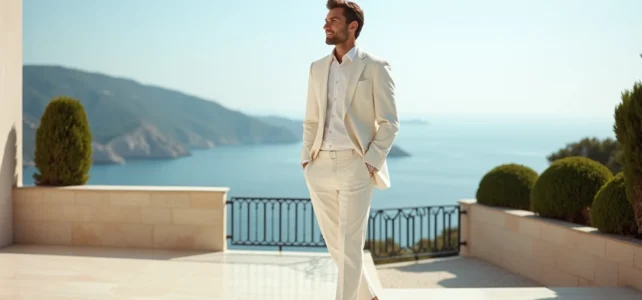
White forgives nothing. A stain, a crease, a cheap material: everything shows. It is precisely this textile demand that makes it a marker of class before being a matter of taste. When the ultra-rich choose to dress in white, they display an ability to maintain, replace, and assume a garment that most people avoid out of caution.
Textile constraints of white: weight, fibers, and professional care
A quality white garment relies on a technical specification that is stricter than any other color. White amplifies every manufacturing defect: transparency if the weight is too low, accelerated yellowing on synthetic fibers, and immediately visible pilling on low-quality jersey.
Luxury houses work with white based on long-fiber cotton (Sea Island, Supima) or European linen, materials whose lightfastness and wash resistance are incomparable to standard cotton. The production cost of a long-fiber cotton white t-shirt can represent several times that of a classic combed cotton equivalent.
Care constitutes the other invisible barrier. A total white look worn for a day at a Mediterranean beach club often ends up at the dry cleaners that very evening. Palace clients have integrated laundry services, with stain removal protocols tailored to natural fibers. The question of the spiritual meaning of wearing white takes a back seat when observing the actual logistics that this color imposes daily.
Wearing white signals, without a word, that one has the time, money, and infrastructure to maintain an impeccable appearance at all times.

White and social distinction: a deliberate break from fast fashion
French people have bought more new clothes in recent years, driven by ultra-fast fashion and its rock-bottom prices. In the face of this massification, neutral white becomes a tool for visual separation for the affluent classes.
Luxury houses reinforce neutral colors (white, ecru, ivory) in their summer collections to create maximum contrast with the saturated prints and bright colors that dominate low-cost fashion platforms. The reasoning is clear: the more mass consumption becomes colorful, the more silent white becomes a sign of refinement.
Media sociologist Jamil Dahklia, quoted by Madame Figaro, speaks of white as a “privilege.” The term is accurate in terms of clothing. Wearing white pants in a crowded subway or on a construction site is a matter of practical recklessness. White signals a lifestyle protected from the dirt of everyday life, making it a more effective class marker than an obvious logo.
The case of the total white look for men
For wealthy men, the all-white look remains rarer and therefore more noticeable. Jeff Bezos, photographed in Saint-Tropez, opted for a navy polo and black chinos, not for a total white look. Ultra-rich men often prefer a white piece (linen shirt, polo) combined with dark colors.
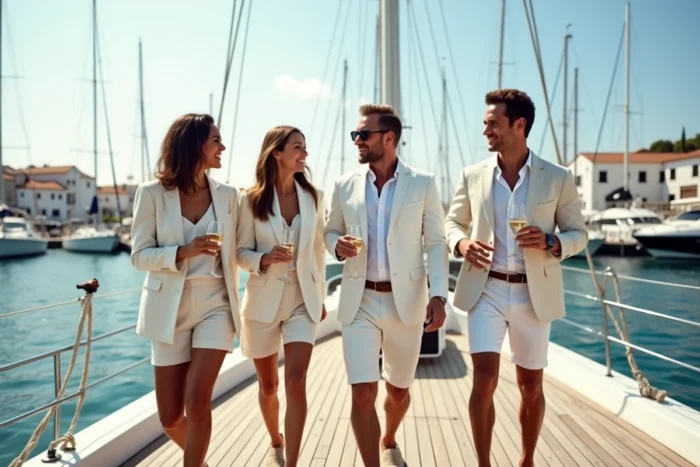
The total white look for men is still associated with very codified contexts: regattas, garden parties, ceremonies on yachts. Outside of these settings, it quickly tips into ostentation, which discreet wealth (“quiet luxury”) precisely seeks to avoid.
White color and luxury venue codes: an imposed aesthetic
The white worn by the wealthy cannot be understood in isolation. It fits into a coherent visual ecosystem. Palaces, beach clubs, and high-end residences build their identity around light palettes: white walls, ecru linen furniture, immaculate tablecloths.
Wearing white in these spaces is as much about mimicry as it is about personal choice. The garment harmonizes with the decor, creating an impression of continuity between the body and the environment. Conversely, a colorful outfit in an all-white restaurant inadvertently draws attention.
This logic also works in the other direction. French decree n° 2025-482, which came into effect on July 1, 2025, imposes thermal constraints on the uniforms of security personnel, with attention to the color of summer outfits. Light colors, including white, are favored to limit heat absorption. Service staff thus adopts shades close to those of the clients, reinforcing the visual homogeneity of luxury venues.
- Mediterranean beach clubs often impose a dress code in white or neutral tones to maintain their visual identity on social media, with each client becoming a part of the photographable decor.
- Private yacht events favor white for practical reasons (light reflection, thermal comfort) as much as for aesthetic ones.
- Pop-up stores of luxury brands located near seaside resorts highlight white pieces in their windows, calibrated for the local context.
Symbolism of white in luxury fashion: purity, power, and silence
Beyond technique and sociology, the color white carries a symbolic weight that luxury brands exploit with precision. White refers to purity, light, a form of transcendence that goes beyond the garment.
In haute couture shows, a white dress closing a collection almost always signals the centerpiece. Chanel has made white one of its chromatic pillars, alternating with black. White in fashion signifies absolute mastery of technical gesture, because no dye can mask a cut or finishing flaw.
This dimension aligns with the trend of “quiet luxury” that has dominated high-end fashion for several seasons. No logo, no garish color, no recognizable pattern: the white garment, sober and perfectly tailored, communicates luxury by subtraction. The less one shows, the stronger the message for those who know how to read it.
The wealthy do not wear white by chance or merely for aesthetic preference. They wear a color that demands resources, that fits into spaces designed for it, and that conveys a philosophy of luxury based on apparent erasure. White is, in fashion as in architecture, the zero degree of the superfluous, and that is precisely what makes it so costly to maintain.