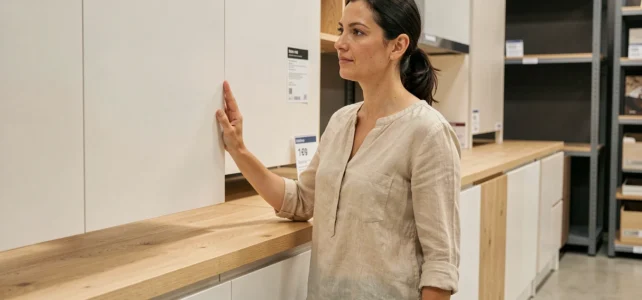
The Ikea cabinets made of 18 mm particle board and the But Signature cabinets made of 16 mm do not offer the same structural rigidity, and this detail affects the durability of the entire kitchen. Before choosing between these two brands for budget-friendly furnishing, we recommend looking beyond the displayed entry price in the store.
Cabinet Thickness and Hardware: The Real Technical Gap Between But and Ikea
At Ikea, the Metod range is based on cabinets made of 18 mm particle board with a 3 mm fiberboard back. This standard thickness allows for better hinge performance in use, especially on upper cabinets subjected to repeated openings.
But offers two distinct lines. The Box range (ready-to-go) uses thinner panels with entry-level hardware. The Signature range, custom-made, increases in quality with a 10-year warranty compared to 2 years for the Box. The warranty gap directly reflects the difference in fittings, hinges, and drawer systems.
We observe that integrated soft-close hinges are standard at Ikea (Utrusta range), while they remain optional or absent in entry-level But configurations. On a project of 15 to 20 cabinets, this item represents a discreet but real additional cost if you need to add them later.
For those who want to compare a But or Ikea kitchen on Miss Déco, the distinction between these two finishing levels is the first filter to apply even before discussing budget.
Ikea vs But Kitchen Budget: What the Displayed Price Really Covers

The price displayed in the window or on a configurator tells only part of the story. Ikea positions its equipped kitchens in a range of approximately 3,000 to 8,000 euros including installation, according to recent comparative sources. But, with its Signature range, is positioned in a broader segment that significantly exceeds this for turnkey projects.
The difference lies in what each brand includes or excludes from the quote:
- At Ikea, the catalog price covers the cabinets, fronts, and basic hardware, but installation is handled by an external provider (TaskRabbit or independent craftsman). The installation cost varies by region and project complexity.
- At But, the Signature range includes a single point of contact who manages the design, delivery within two to three weeks, and installation. This all-in-one service simplifies the project but is reflected in the overall price.
- Appliances are rarely included in both cases at the entry price. Ikea offers its own brands (Matmässig, Lagan) at aggressive prices, while But distributes third-party brands with occasional promotions.
In recent years, the prices of equipped kitchens in France have been steadily rising due to the increase in raw material and logistics costs. Recent forecasts indicate a more moderate increase, around a few percentage points per year. In this context, the price gap between Ikea and But is narrowing in the mid-range.
Customization and Tailoring: Where Each Brand Reaches Its Limits
Ikea excels in standardized modularity. The online configurator (recognized as the best on the market by several comparisons) allows for combining fixed-size cabinets with a wide choice of fronts. Third-party manufacturers even offer alternative fronts and handles compatible with the Metod system, opening up aesthetic possibilities that the catalog alone does not cover.
This approach has a trade-off: the dimensions of Ikea cabinets are not adjustable to the centimeter. In a room with irregular walls or atypical corners, fillers and end panels must be planned, complicating assembly and potentially leaving unsightly gaps.
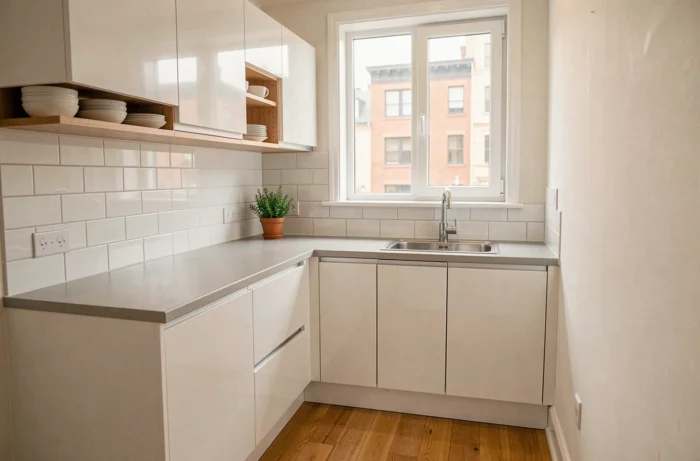
But Signature takes the opposite approach with custom-made furniture. The cabinets are manufactured to the exact dimensions of the room after a measurement in-store. For an L-shaped kitchen with a non-standard angle or a sloped ceiling, this option avoids dimensional compromises.
The downside: aesthetic customization at But remains more limited than at Ikea in terms of available colors and finishes. And delivery times (two to three weeks announced) can extend during peak demand periods.
Flat-pack or Installed Kitchen: What Level of Autonomy to Expect
The choice between But and Ikea also depends on your ability to manage a project. Ikea imposes a logic of flat-pack kitchen that you assemble yourself or have installed by a third party. This requires proper tools (drill, laser level, clamps) and good reading of assembly plans. An experienced DIYer can assemble a medium-sized Metod kitchen in two to three days.
But, with the Signature range, offers a guided process: design in-store with a dedicated kitchen designer, delivery, and installation by partner installers. The Box range, on the other hand, follows the same logic as Ikea (ready-to-go, self-assembly) with immediate availability in-store.
We recommend not underestimating the hidden cost of self-management at Ikea: vehicle rental for transport, purchase of specific tools, time spent, and risk of assembly errors. A drilling error on a laminate countertop is not recoverable, and replacing the piece can extend the project by several days.
Countertops and Materials: Laminate, Wood, or Quartz at Low Prices
The countertop represents the area where the two brands diverge the most in terms of value for money. Ikea offers laminate (Säljan range) and solid wood (oak or birch) countertops at competitive prices. Ikea’s laminate provides good moisture resistance for its price, but its visible edge reveals the particle board underneath.
But includes high-pressure laminate or quartz countertops in its Signature quotes depending on the budget. Quartz, more resistant to scratches and heat, remains a higher investment but is more easily negotiated in a global quote than at Ikea where each element is purchased separately.
For a budget project, laminate remains the rational choice at both brands. The real question concerns thickness: a 38 mm countertop withstands cuts for sinks and hobs better than a 28 mm model, regardless of the brand.
The choice between But and Ikea rarely boils down to a question of raw price. The structure of the project (flat-pack or installed, standard or custom, skilled DIY or total delegation) weighs as much as the initial quote. Taking the time to compare detailed quotes, item by item, with and without installation, remains the only reliable method to identify the truly cheapest option for your configuration.