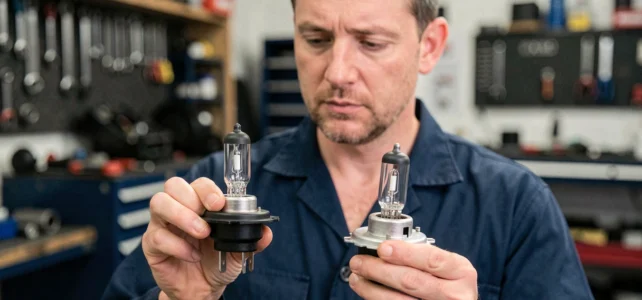
H1 or H7 bulb: the two look similar on an auto parts store shelf, but they are not interchangeable. Their base, their position in the optical block, and their role in vehicle lighting differ. Understanding what separates these two references helps avoid an unnecessary purchase, or even a rejection during the technical inspection.
Base, beam, and installation: what physically distinguishes an H1 from an H7
The confusion between H1 and H7 arises from the fact that both are single beam bulbs (one filament). Neither combines low beam and high beam on the same filament, unlike the H4 which integrates two filaments.
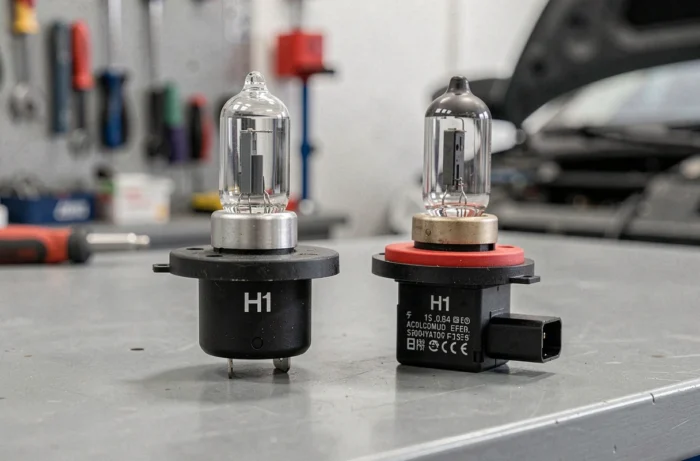
The difference lies in the base. The H1 uses a P14.5s base, which is older, with a metal tab for securing it. The H7 relies on a PX26d base, which is wider, designed for locking with clips or retaining tabs in more recent optical designs.
Understanding the difference between H1 and H7 bulbs comes down to this point: the two bases have incompatible dimensions and fastening systems. An H1 does not fit in an H7 slot, and vice versa.
| Characteristic | H1 Bulb | H7 Bulb |
|---|---|---|
| Base type | P14.5s (tab) | PX26d (clips/tabs) |
| Number of filaments | 1 | 1 |
| Main usage | High beam, fog lights | Low beam, high beam |
| Generation of optics | Older | Newer |
| Interchangeability | No | No |
High beam, low beam: which bulb for which use
On vehicles equipped with a single slot per optical block, it is generally an H4 (dual filament) that serves both functions. H1 and H7 pertain to vehicles with two distinct slots per headlight.
In this configuration, several combinations exist:
- H7 for low beam and H1 for high beam (common combination on European vehicles from 2000-2010)
- H7 for low beam and H7 for high beam (common on newer models)
- H1 for both functions (rarer, especially on older vehicles)
The H7 has gradually become the standard for low beams because PX26d optics offer more precise filament positioning. The H1, however, remains widely used for front fog lights on many models.
The vehicle’s maintenance manual indicates the exact reference for each slot. In case of doubt, opening the optical block and reading the label on the installed bulb remains the most reliable method.
LED kits with H1 or H7 base: the non-homologation trap
So-called “retrofit” LED kits, which take the shape of an H1 or H7 base to fit into an original halogen optic, are multiplying online. Their promise: whiter light, longer lifespan, and reduced consumption.
The problem is regulatory. Almost all retrofit LED kits H1 and H7 remain unapproved for road use in France. Installing an LED in a projector designed for a halogen alters the distribution of the light beam. The cutoff line, which prevents dazzling oncoming drivers, may become misaligned or poorly defined.
Concrete risks during technical inspection and on the road
The technical inspection now checks more for the actual beam produced by the headlight, not just the presence of a functional bulb. A poorly oriented or dazzling beam can lead to a rejection.
Driving with an unapproved LED bulb in a halogen projector exposes you to a fixed fine of 135 euros (4th class offense). In case of deemed dangerous dazzling, the vehicle may be immobilized.
Before replacing a halogen H1 or H7 with an LED, checking that the kit has specific approval for the concerned vehicle model is the only precaution that matters. The labels “compliant” or “CE quality” on the packaging do not constitute official approval.

Choosing between H1 and H7: the practical method
The choice between H1 and H7 is not a matter of preference. It is the vehicle manufacturer that has determined which base fits into each slot of the optical block. Here’s how to identify the correct reference without risk of error:
- Consult the maintenance manual or technical notice of the vehicle, which specifies the reference for each function (low beam, high beam, fog lights)
- Remove the installed bulb and read the engraving on the base or glass (H1, H7, H4, etc.)
- In the case of a versatile optical block with two slots, note that each slot accepts only one type of base
- Never force a bulb into a slot that seems incompatible: an H1 base in an H7 housing damages the contacts
Replacement should be done in pairs. Changing only one bulb creates a color and intensity imbalance between the two headlights, which the technical inspection may notice.
The bulb reference also determines the available technological choice. Halogen ranges “+80 %” or “+130 %” exist in both H1 and H7. They increase the light range without altering the base. This is the only real margin for improving lighting without stepping outside the approved framework.
At the time of replacement, the question to settle is therefore not H1 or H7, but rather: which technology to choose within the correct base reference. The base, however, is dictated by the vehicle.