When examining the production chain of a Cabaïa bag, the question is less about the manufacturing location than about the criteria that determine the choice of each site. The French brand, founded in Paris, distributes its production across several countries based on specific technical, ethical, and economic parameters. How do these parameters compare from one site to another, and what portion of the range now incorporates recycled materials?
Cabaïa Production Countries: Geographic Distribution and Selection Criteria
| Country | Type of Production | Main Criteria |
|---|---|---|
| Thailand | Backpacks, luggage | Technical excellence, textile industrial capacity |
| Vietnam | Bags, accessories | Advanced textile know-how, large volumes |
| Cambodia | Textile accessories | Technical skill, consistent pricing |
| China | Components, accessories | Cutting-edge technologies, logistical capacity |
| Turkey | Hats, scarves | European proximity, knitting expertise |
| Poland | Some accessories | European manufacturing, short lead times |
Each partner adheres to a specification sheet covering four areas: technical excellence, compliance with ethical and environmental standards, capacity to absorb order volumes, and pricing transparency. Several sites utilize solar panels, electric vehicles for employees, and eco-optimized manufacturing processes.
To delve deeper into the production of Cabaïa bags, it is noteworthy that the brand explains its lack of domestic production by the disappearance of industrial textile know-how in France since the 1970s. Technical capacity has developed in Asia and Eastern Europe over more than fifty years.
Recycled Materials in Cabaïa Bags: GRS Certified Polyester and Nylon
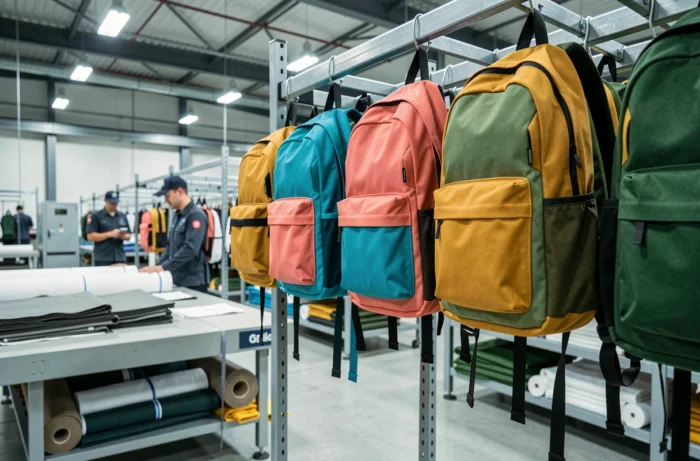
The most measurable evolution concerns the integration of recycled materials. For the winter 2024 collection, Cabaïa indicates that 67% of the bags contain GRS certified recycled plastic (Global Recycled Standard). This figure covers backpacks and shoulder bags.
Product sheets posted online in 2025 and 2026 on distributors like Speak.fr confirm this trend. Several recent references (crossbody, bum bags, tote bags) feature a composition of 100% recycled polyester or 100% recycled nylon. These materials come from textile waste or plastic bottles.
The GRS certification ensures the traceability of recycled material throughout the supply chain. It also imposes social and environmental criteria on processing sites. For Cabaïa, this means that recycling is not just a marketing argument: it is verified at every stage, from sorting the raw material to producing the final fabric.
Impact Reduction Measured by the Brand
Cabaïa links the shift to recycled materials with a reduction in water consumption and CO2 emissions compared to the production of virgin polyester. The brand does not publish a carbon footprint report on a product-by-product basis, but the use of GRS provides a standardized evaluation framework.
Ethical Audits and B Corp Certification: What This Changes in the Production Process
Cabaïa is B Corp certified, an international label that assesses social and environmental performance and transparency in companies. This label does not only concern the brand itself: it encompasses the entire value chain, including subcontractors.
All manufacturing partners are regularly audited. The brand claims that every employee at its production sites receives a fair and equitable wage, and that no children are employed. These audits cover:
- Working conditions (hours, safety, remuneration) at each production site in Asia and Europe
- Environmental compliance of processes (wastewater management, energy consumption, textile waste treatment)
- Traceability of raw materials, including verification of GRS certification for recycled materials
However, the details of the audit reports are not made public. The B Corp certification operates on a global rating of the company, not through the publication of reports site by site. Therefore, consumers have a reliable but aggregated indicator.
Design in France and Outsourced Production: How Cabaïa Structures Its Steps
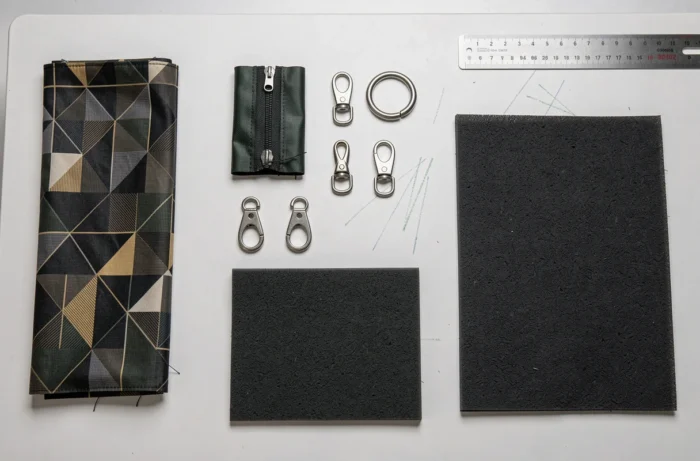
The design of Cabaïa products is done in France, in Paris. The creation steps (color choices, patterns, dimensions, functionalities) are managed internally. Prototyping involves back-and-forth communication with partner factories to validate technical feasibility.
The system of interchangeable pouches on backpacks illustrates this articulation. The modular design (allowing for the customization of the same bag with different removable pouches) requires an assembly precision that partner factories guarantee through their textile specialization.
Hats, Socks, and Accessories: Distinct Supply Chains
Manufacturing does not follow a single circuit. Hats and scarves go through Turkey, which has a strong knitting supply chain. Socks follow a different circuit. This diversification of suppliers based on technical expertise, rather than seeking the lowest cost, distinguishes the Cabaïa model from simple opportunistic outsourcing.
Each product category (backpacks, luggage, hats, socks, beach towels) engages a selected partner for their expertise in that specific type of textile or accessory. The choice of site depends on know-how, not just price.
The shift to over two-thirds of bags incorporating certified recycled plastic, combined with B Corp certification and regular audits of production sites, outlines a model where traceability becomes the true quality indicator. For a brand that does not manufacture in France, it is on these verifiable data that the credibility of the approach rests.