Decor trends evolve in cycles, but those emerging for the coming months mark a clearer break from the cold minimalism that has dominated for a decade. Earthy palettes, organic shapes, and a demand for traceability in materials: current directions reflect a relationship with interiors where sensory comfort takes precedence over visual simplicity. Here’s an overview of the axes that truly structure these evolutions, beyond inspiration lists.
Warm minimalism: why minimalism is changing its tune
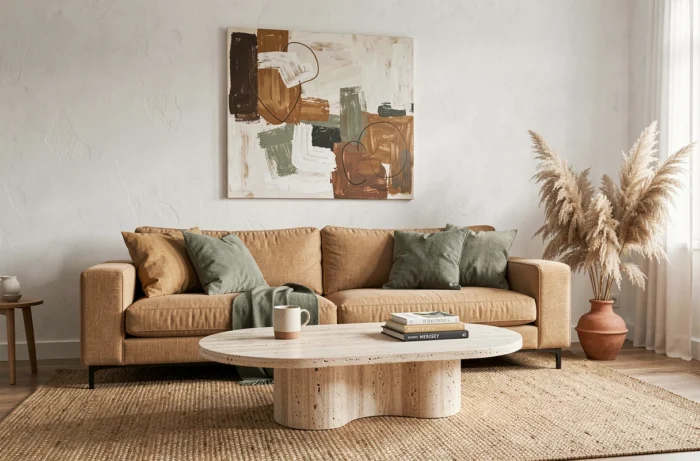
The term appears in most recent decor analyses, and it refers to a specific trend. Warm minimalism retains the principle of a stripped-down space but replaces smooth, gray, or white surfaces with cream, sandy, warm greige, and natural wood tones. The change is as much about color as it is about texture.
Tactile textiles (thick linen, boucle wool, brushed cotton) take the place of stretched synthetic fabrics. Furniture maintains simple lines, but the materials breathe more. A sofa with deep cushions in a textured fabric replaces the angular model in anthracite faux leather.
This shift is not merely a change in palette. It reflects a demand for physical comfort in domestic spaces, amplified by remote work. Spending eight hours a day in a room imposes constraints that magazine decor, designed for photos, did not address. Browsing decor articles on Parlons Déco allows you to see how this transition is concretely expressed, room by room.
Curved shapes and organic furniture: an independent decor axis
Rounded silhouettes are no longer a mere aesthetic detail. Arches in partitions, circular tables, sofas with soft lines, oval mirrors: curved shapes now constitute a fully-fledged decor axis. Several recent sources clearly distinguish them from other trends, where they were previously drowned in the “designer furniture” category.
The interest in these shapes goes beyond appearance. A rounded chair back better conforms to the spine. A table without sharp angles alters circulation in a narrow room. Usability comfort aligns with decorative intent.
Which spaces benefit the most
The living room and dining room concentrate the majority of applications. A semicircular sofa restructures a large open living room without partitioning. In the dining room, a round or oval table encourages conversation and adapts better to small spaces than its rectangular counterpart.
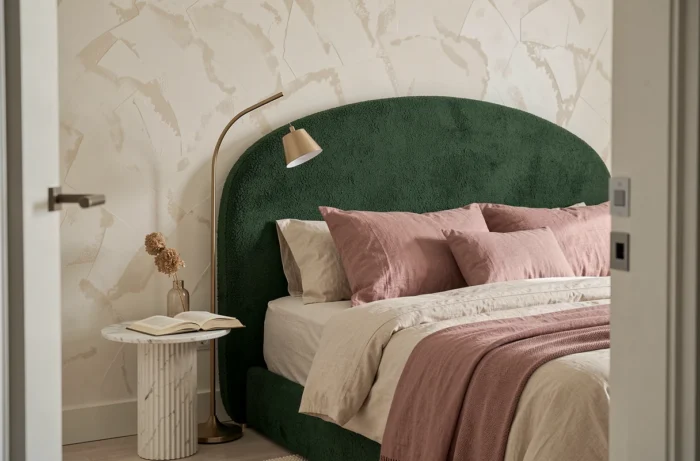
The bedroom follows this logic with rounded headboards and bedside tables with softened edges. Bathrooms, on the other hand, remain more constrained by technical layout, and curved shapes are often limited to mirrors or basins.
Biophilic design: beyond green plants
Placing three pots on a shelf is no longer enough to qualify an interior as “natural.” The biophilic design as it develops integrates nature into the very structure of the space. This involves several distinct levers:
- Maximization of natural light: enlarging openings, removing opaque curtains, using glass partitions to redistribute light in windowless rooms
- Vegetal walls integrated into the architecture, not just hung as decoration, with integrated irrigation systems to ensure durability
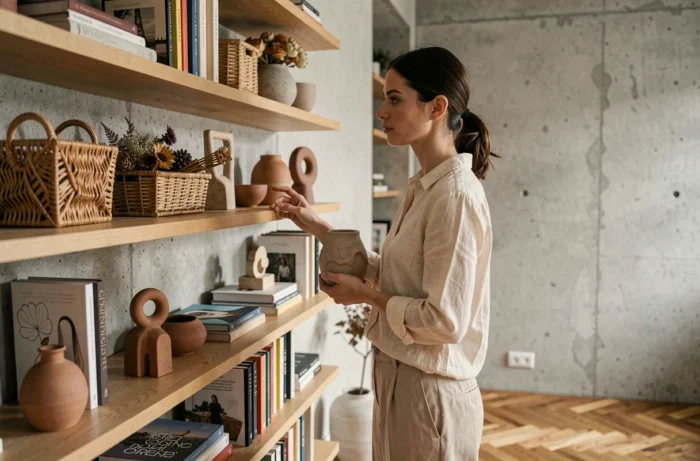
- Systematic use of raw materials (stone, untreated wood, rammed earth) that retain their surface irregularities instead of being sanded down to look synthetic
- Color palette mirroring natural variations: deep greens, terracotta, clays, golden sands
This approach requires preliminary work, from design or renovation. Integrating a functional green wall or modifying openings is not just a simple facelift. Biophilic design involves structural choices, not just decorative ones.
Material traceability and sustainability: what clients really want
Sustainability in decor has long been a showcase argument. Recent analyses show a shift towards a more concrete demand. Buyers are asking for proof of the origin of materials, the reparability of furniture, and the actual longevity of products.
This change modifies selection criteria. A solid wood piece whose species and origin are identified takes precedence over a laminated equivalent, even at a higher price. The possibility of replacing a part (table leg, chair seat, sofa cover) becomes a selling point.
Ethical materials and responsible production
Recycled fabrics, low-VOC paints, and formaldehyde-free glues are gaining ground. Traceability is shifting from a marketing discourse to a requirement for documented proof. Some manufacturers are beginning to provide sheets detailing the complete life cycle of the product.
Field feedback varies on this point: not all market segments are at the same level of demand. High-end furniture more easily incorporates these criteria than accessible decor, where price remains the primary filter. The trend exists, but its diffusion remains uneven across ranges.
Trendy decor colors: terracotta, deep green, and the return of greige
The dominant palettes are organized around three families. Terracotta and its variations (clay, ochre, muted brick) occupy the warm register. Deep green, close to forest green or dark sage green, adds density without darkening. Greige (a contraction of gray and beige) serves as a warmer neutral base than pure gray.
These three families combine without neutralizing each other. A terracotta wall with a greige sofa and sage green cushions creates a cohesive atmosphere without monotony. The addition of natural materials (rattan, jute, linen) reinforces the overall coherence.
Bright colors (curry yellow, midnight blue) have not disappeared, but they appear in touches: a vase, a frame, a light fixture. Their role is that of an accent, not the dominant one. This restraint in the use of strong color well characterizes the current direction: creating warmth through mid-tones rather than contrast through extremes.
Current decor trends share a common thread: they place use and feeling at the center of choices. Traceable materials, shapes that serve comfort, palettes designed for everyday life rather than for photos. Interior decoration, in its most relevant version, becomes a balance between what is seen and what is experienced.