
Baking soda mixed with an acid like white vinegar produces gaseous carbon dioxide. This gas, heavier than air, forms a visible mist when it carries water droplets or vapor in suspension. The reaction is quick, poses no particular danger on a small scale, and requires only ingredients commonly found in the kitchen.
Acid-base reaction: what actually produces the baking soda smoke
Sodium bicarbonate (NaHCO₃) is a weak base. In contact with an acid, it decomposes, releasing gaseous CO₂, water, and a salt. With white vinegar (acetic acid), the reaction is nearly instantaneous: the visible fizz corresponds to the CO₂ bubbles bursting at the surface.
This gas release, in a humid environment, carries fine droplets with it. It is this combination of gas and microdroplets that creates a whitish smoke effect. The smoke is therefore not smoke in the combustion sense, but an aerosol.
A point often misunderstood: sugar, sometimes mentioned in recipes, does not participate in the chemical reaction. It may slightly thicken the mixture, but does not increase either the amount of gas or the visual intensity. To make smoke with baking soda, the baking soda-vinegar duo is sufficient.
Concrete method to produce smoke with baking soda and vinegar
The handling consists of a few simple steps. The materials can be found in any kitchen.
- Pour about two tablespoons of baking soda into a wide container (mixing bowl, saucepan, open jar)
- Gradually add white vinegar in small amounts to control the fizzing and prolong the visual effect
- Add a few drops of dish soap if the goal is to produce a dense foam that traps CO₂ longer at the surface
- Use warm water to moisten the baking soda before adding the vinegar, which can slightly slow the reaction and spread the gas release
The effect is more spectacular in a narrow and tall container (like a cut bottle or wide tube), as the gas concentrates before overflowing. A wide container disperses the gas too quickly and reduces the visibility of the smoke.
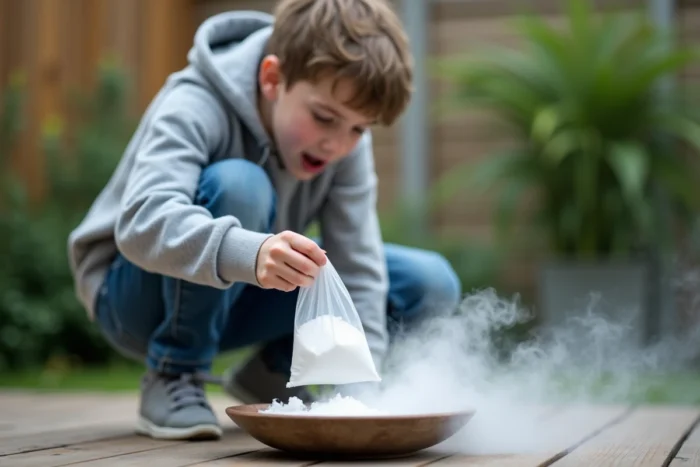
The amount of vinegar determines the duration of the reaction. Pouring it all at once gives a brief peak of fizzing. Pouring in small doses of a few milliliters each allows for multiple gas releases.
Safety of homemade smoke experiments: an often overlooked angle
Tutorials generally present the baking soda-vinegar reaction as completely harmless. On a small scale and in a ventilated environment, this is true. Recent recommendations on indoor air quality, especially in places hosting children, call for a precaution that these same tutorials often overlook.
Never confine the reaction in a closed container. The produced CO₂ builds up pressure. Even a small volume of baking soda and vinegar in a capped bottle can create enough pressure to pop the cork or crack the container. This risk also applies to baking soda rocket setups, where the principle relies precisely on this pressure, but with more unpredictable control than it seems.
Home science guides, including those supervised by educational institutions, now emphasize systematic ventilation of rooms during repeated manipulations. CO₂ is not toxic at low concentrations, but multiple consecutive reactions in a closed room can noticeably degrade air quality (headaches, drowsiness).
Prolonged skin contact with dissolved baking soda also deserves attention. Recent guides on its household uses indicate risks of irritation and drying, especially in children. Wearing thin gloves during long or repeated handling is a reasonable precaution.
Variations of the experiment: volcano, invisible ink, and artificial snow
The baking soda-vinegar reaction serves as the basis for several fun experiments that exploit the same chemical principle in different forms.
The baking soda volcano is the most common variant. A mound of modeling clay or papier-mâché forms the structure. The mixture is poured into the crater. Adding red or orange food coloring to the vinegar creates a lava effect. The fizz overflows from the crater by gravity, amplifying the illusion.
Baking soda invisible ink works on a different level. Baking soda is dissolved in water, written with this solution on white paper, and then the message is revealed by brushing with grape juice or diluted turmeric. The reaction between the base and the colored indicator makes the text appear. No smoke here, but the same acid-base principle at work.
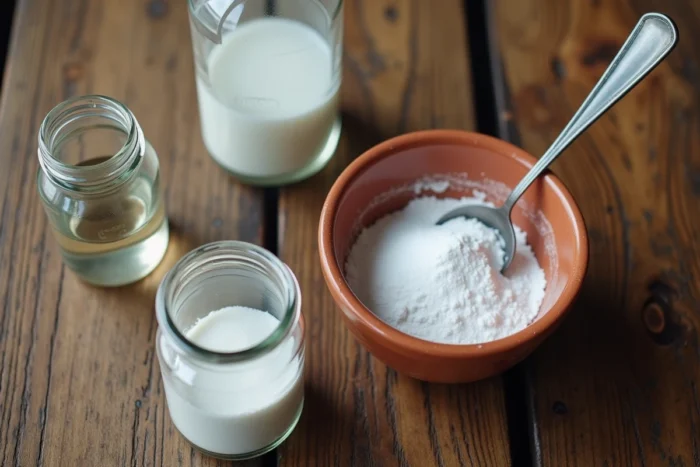
Artificial snow combines baking soda with shaving cream or conditioner. The result is a crumbly white paste that mimics the texture of snow. This variant does not produce gas but uses the fine granularity of baking soda for a visual and tactile effect.
Do these experiments replace a real chemistry class?
The “home science” programs offered by some academies and museums use the baking soda-vinegar reaction as an entry point to concepts of acid, base, and gas release. The educational interest lies in the simplicity of the protocol and the immediacy of the visible result.
The limit is equally clear. The reaction does not allow for the exploration of stoichiometry, chemical equilibria, or thermodynamics. It illustrates a phenomenon without explaining it in depth. Educational institutions that incorporate these experiments accompany them with written support that contextualizes the reaction, names the products formed, and connects observation to a concept.
Reproducing the experiment without this framing provides a spectacle, not a learning experience. The difference between the two lies in a simple question asked before or after the manipulation: what gas is formed, why does it foam, and what remains in the container once the reaction is complete. The residue (sodium acetate dissolved in water) is itself a chemical product with interesting properties, notably its ability to crystallize while releasing heat.