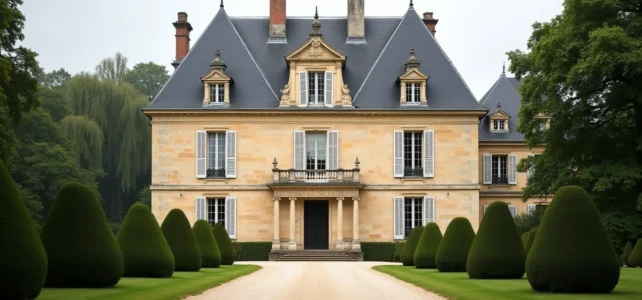
The Château de Groussay, located in Montfort-l’Amaury in the Yvelines, is currently owned by a SCI Château de Groussay. This real estate civil company serves as the legal vehicle that holds the estate, which has been classified as a historical monument since 1993. Behind this structure lies decades of complex transmissions, a unique aesthetic heritage, and international legal disputes that have placed this property at the crossroads of French heritage and the fight against money laundering.
Setting up a SCI and the opacity of real estate ownership at Groussay
For large classified properties, using a SCI allows for the separation of the management of the asset from the individual who controls it. The maintenance costs of a historical monument are pooled, and the succession transfer occurs through the sale of shares rather than direct sale of the property.
In the case of Groussay, this structure makes identifying the ultimate owner less transparent. Public records mention the SCI, but finding the current owner of the Château de Groussay on Immotive requires tracing the chain of associates and financial arrangements that accompanied the recent transactions.
This type of ownership is not illegal in itself. The SCI remains the most common mode of ownership for private châteaux in France. It is the source of the funds invested in the acquisition that has posed a problem for Groussay.
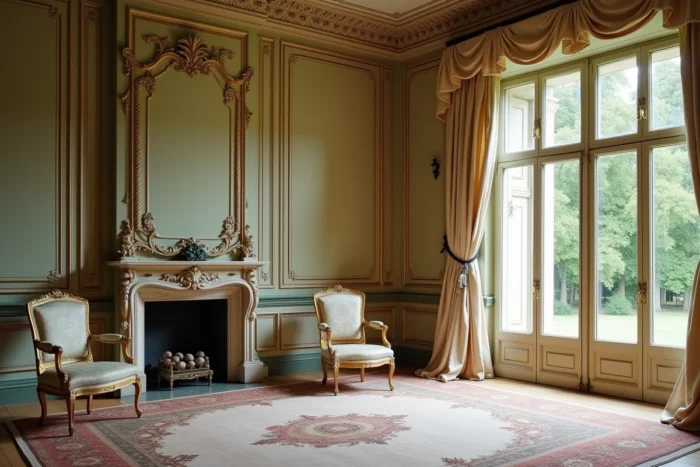
Duchesse de Charost and Charles de Beistegui: the two founders of the estate
The château was built starting in 1815 for the duchesse de Charost as a country house. The original building was a classic residence, without any particular monumental pretension.
It was Charles de Beistegui, a Franco-Mexican collector and aesthete, who transformed Groussay during the 20th century. He acquired the estate and expanded it spectacularly, adding a private theater, a grand library, and especially a park dotted with garden follies inspired by international models:
- A Tartar tent, replicating a pavilion inspired by Ottoman design, with a textile structure and painted decorations
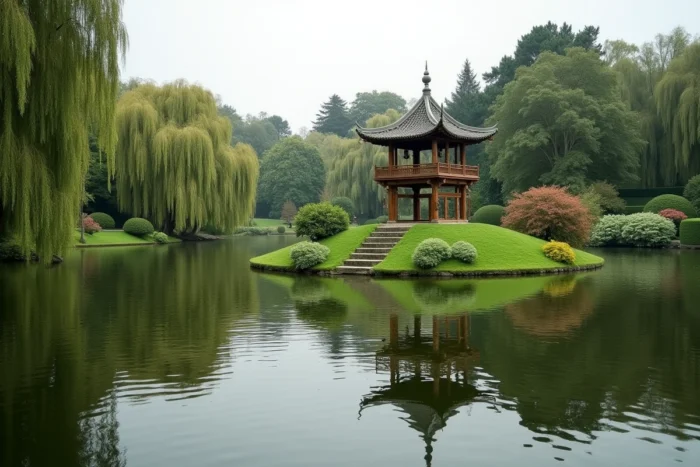
- A Chinese pagoda, built to scale with an interior adorned with lacquers and chinoiseries
- A Palladian bridge and a rostral column, direct references to classical English and Roman architecture
Beistegui carried out these works over several decades, until around 1970. His ambition was to create a living space that also served as an artistic manifesto, blending references to European, Ottoman, and Asian art within the same park in the Yvelines.
The Karimova case and disputed funds linked to the purchase of the château
After Beistegui’s death, the estate changed hands. The acquisition that attracted the attention of judicial authorities is linked to the network of Gulnara Karimova, daughter of former Uzbek president Islam Karimov.
Several investigations, including one by the Public Prosecutor’s Office of the Swiss Confederation, established that Karimova was at the center of a corruption system in the telecommunications sector in Uzbekistan. Operators like Telia and VimpelCom were involved in paying bribes to obtain licenses. The funds from this system were laundered through luxury real estate acquisitions in Europe.
Groussay is among the properties identified in these circuits. The château has been placed under sequestration as part of international confiscation proceedings. The cooperation between French and Swiss authorities has allowed for the freezing of assets linked to this network, a process that is part of a broader movement for traceability of luxury assets acquired with illicit funds.
Consequences for the management of the estate
A property under sequestration remains legally owned by its owning structure (here the SCI), but management, sale, or transformation decisions are suspended or subject to judicial authorization. For a classified historical monument, this situation creates a concrete risk: routine maintenance work may be delayed, and the cultural enhancement of the site becomes uncertain.
Classified heritage and the future of the Château de Groussay
The classification as a historical monument, obtained in 1993, protects the château and its park from unauthorized modifications. This protection covers both the main building and the garden follies, making it a rare heritage ensemble in Île-de-France.
The question that arises today concerns the relationship between heritage protection and judicial constraints. As long as the procedures related to the Karimova case are not fully resolved, the status of the estate remains suspended between two logics: that of heritage conservation and that of international justice.
Initiatives for artist residencies and occasional public openings have been mentioned to maintain cultural activity on the site. This type of program allows for justifying maintenance investments while giving a function to the place, but it directly depends on the authorizations related to the legal status of the property.
The case of Groussay illustrates a situation that concerns other prestigious properties in France and Europe. When a classified château finds itself at the heart of an international confiscation procedure, heritage protection comes into tension with asset freezing. The resolution of this tension, at Groussay and elsewhere, will depend as much on judicial decisions as on the ability of heritage authorities to maintain the physical integrity of the estate during the duration of the proceedings.