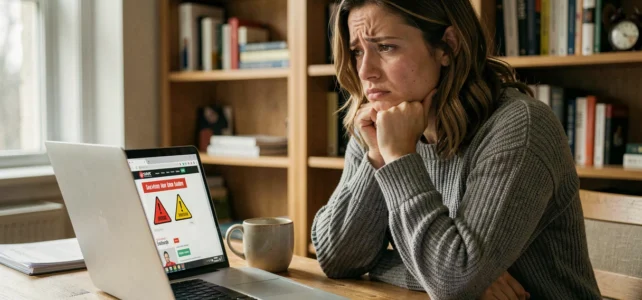
Maficheclasse, Mafutureclasse, TrouveClasse, VoirTaClasse: these domain names refer to fraudulent sites that claim to reveal a student’s class before the school year begins. The Ministry of Education confirms that no official platform allows access to this information before it is communicated by the institution. Understanding the mechanism of these scams helps identify warning signs and react before any personal data is leaked.
Data collection and hidden subscriptions: the technical mechanism of the Maficheclasse scam
The operation of these sites relies on a two-step mechanism. The first step involves requesting personal information (name, first name, institution, school level) under the pretext of retrieving the class list. The form deliberately mimics the appearance of an official service related to the Ministry of Education.
The second step marks an evolution from the earlier versions of the scam. The sites no longer just collect data: they redirect to “missions” to complete (contests, app downloads, partner offers). These missions can lead to unwanted subscriptions or attempts to capture banking data.
In practice, the user never receives their class list. The site displays a fake loading screen, then offers to “unlock the result” by completing an additional action. Each action generates a commission for the site operator or feeds a database sold to third parties. Before reaching this point, knowing the steps to take against Maficheclasse allows you to cut off the scam at the first signs.
Warning signs on a fraudulent school site: what should block data entry
Several clues can help identify a fraudulent site even before filling out a form. Spotting them prevents the transmission of any personal data.
- The URL does not correspond to any official domain of the Ministry of Education. Legitimate platforms use addresses ending in .gouv.fr or .education.fr, never commercial names like “ficheclasse” or “trouveclasse” followed by .com or .fr
- The site requests information that a class consultation service has no reason to ask for: phone number, parents’ email address, child’s full date of birth
- The page offers “missions” or app downloads in exchange for the result. No official school service conditions access to administrative information on a commercial action
- The legal notices are absent or incomplete: no identified publisher, no physical address, no SIRET number
A simple reflex often suffices: check on the institution’s website or through the digital workspace (ENT) if the class list has been published. If the school has not communicated anything yet, no third-party site can have this information.
Recurring campaign at every school year start: why domain names change
These scams are not an isolated phenomenon. The same mechanism reactivates each year as the school year approaches, with renewed domain names to circumvent previous reports. The versions identified during the 2024 and 2025 school years have been reported, blocked in some cases, and then replaced by new addresses in 2026.
The dissemination vector has also evolved. Links to these sites circulate massively on TikTok, in the form of video tutorials where accounts explain “how to know your class before the school year.” The short format and casual tone of these posts directly target middle and high school students, who then share the link in their messaging groups.
This virality makes individual reporting insufficient. A site blocked by a reporting platform can be replaced within hours by a clone hosted on another domain. The gendarmerie and cybersecurity services regularly alert on this cycle, but the exploitation window remains the last week of August, when families’ impatience is at its peak.
Compromised personal data: react after filling out a fraudulent form
If information has already been entered on one of these sites, several concrete actions can limit the consequences.
Immediately change the passwords of accounts that use the same email address as the one provided. If a phone number has been shared, monitor for unusual SMS or calls in the following days: these numbers may be sold to telemarketing or SMS phishing campaigns.
- Report the site on the Pharos platform (internet-signalement.gouv.fr), the official reporting system for illegal online content
- File a report with the CNIL if personal data of a minor has been collected without valid parental consent
- Contact the bank if banking details were entered during a “mission” or imposed subscription, to oppose and contest the charges
- Notify the school, which can relay the alert to other families via the ENT or the digital correspondence notebook
Filing a complaint remains possible with the gendarmerie or the police station, especially if financial harm is observed. Keeping screenshots of the site and any emails received facilitates the process.
The only reliable source to know a student’s class remains the school itself, through its official channels. Any other promise, regardless of the displayed domain name, falls under the same scheme of fraudulent personal data collection.