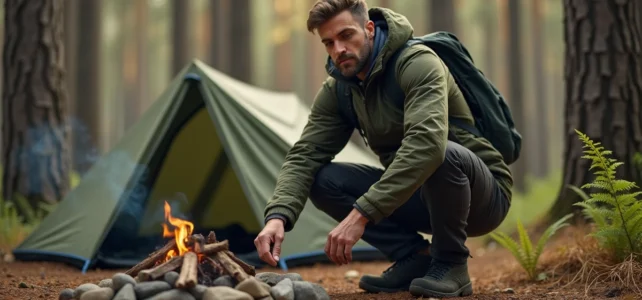
Pitching your tent in the Landes after a day of hiking in the forest means first dealing with a specific terrain: sandy soil, dense forest cover, and a high fire risk for a good part of the year. Before choosing a bivouac spot in the Landes, you must take these constraints into account, or you might end up with a prefectural order on your hands or a night on ground that collapses under your groundsheet.
Sandy soil and pine forest: choosing your bivouac location in the Landes
The Landes forest massif rests on a sandy substrate that changes everything. Loose soil absorbs pegs without resistance, and the tent does not hold well in a southwest wind. We prefer areas where the ground is already compacted by foot traffic: edges of forest paths, frequented clearings, rest areas at the edge of trails.
This criterion of soil resistant to trampling is increasingly mentioned in the recommendations of natural area managers. Mineral or already compacted surfaces limit the impact on vegetation and provide a stable base for bivouacking. In the Landes, this is concretely reflected in DFCI tracks (Forest Fire Defense) and their surroundings, or small grassy spots set back from marked trails.
To know precisely where to bivouac in the Landes, it saves time to identify these areas on IGN maps before leaving, rather than improvising with a headlamp.
Fire risk in the Landes: the constraint that takes precedence over everything else
The Landes forest is one of the most fire-prone areas in mainland France. Prefectural orders can prohibit access to forest massifs from one day to the next depending on the level of danger. This is not a theoretical ban: ONF patrols and forest firefighters actively monitor during the summer season.
In practical terms, this means three things for bivouacking:
- Check the fire risk level on the day of departure, on the Landes prefecture website or the forest fire vigilance map
- Never light a fire, including stoves, in or near the forest massif (even when bivouacking itself is tolerated)
- Prefer areas set back from the canopy: riverbanks, lake edges, open spaces where the risk of fire spread is lower
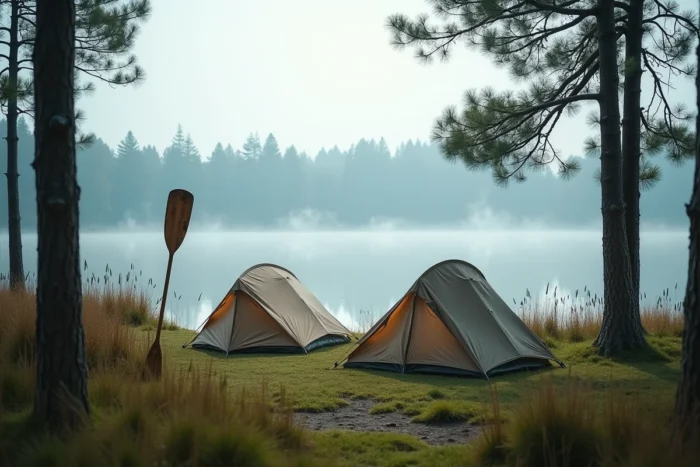
This constraint makes the edges of lakes and rivers doubly interesting. You find more stable ground (clay, short grass) and a natural distance from the flammable forest mass.
Bivouacking around Landes lakes and rivers: the effective zones
The lakes of Biscarrosse, Sanguinet, or Parentis-en-Born logically attract bivouackers. The idea looks good on paper, but the most accessible shores are often classified as regulated areas, with municipal orders prohibiting overnight parking.
Practical spots are found set back from the main access points, on less frequented shores. Around Lake Biscarrosse, the less developed eastern shore offers stretches of bank where one-night bivouacking (setting up after sunset, leaving before sunrise) remains tolerated outside fire restriction periods.
On the river side, the Leyre is the main thread of the Landes de Gascogne Regional Natural Park. Its shaded banks, accessible after a canoe descent, provide natural bivouac locations. The park encourages gentle exploration of the territory, on foot, by bike, or by canoe, with marked routes that traverse a preserved forest landscape.
Bivouacking on the Landes coast: between dunes and regulations
The beaches of the Landes are dreamy, but bivouacking on the beach itself is prohibited along almost the entire coastline. Municipal orders from coastal municipalities (Mimizan, Moliets, Vieux-Boucau) systematically specify this.
The leeway is found in the back-dune areas, in the coastal forest zones that separate the beaches from the roads. These wooded strips, often narrow, allow for pitching a tent for the night as long as the bivouac rule is respected (not before sunset, leaving early in the morning). Feedback on this point varies by municipality, and checking with the town hall before departure remains the most reliable method.
Equipment suitable for bivouacking in the Landes forest
The Landes terrain imposes specific equipment choices. Fine sand infiltrates everywhere, nighttime humidity is marked even in summer, and mosquitoes are present from dusk near wet areas.
- Wide or V-shaped pegs designed for sand replace standard pegs that do not hold in loose soil
- A reinforced groundsheet protects against moisture rising from the sand, which is more pronounced than on rocky or grassy ground
- An integral mosquito net on the tent (not just a simple head net) makes the difference between a decent night and a sleepless night near the Leyre or ponds
- A cartridge stove rather than a wood stove, since any open fire in the Landes forest exposes you to a fine and, above all, a real risk of fire starting
The weight of the equipment matters less here than in mountain bivouacking. The elevation changes are almost nonexistent, allowing you to carry slightly more comfortable gear without ruining your back.
Bivouacking in the Landes is earned more through preparation than physical effort. A spot identified on a map, an order verified the day before, ground tested before pitching: it’s this simple logistics that separates a good night in the forest from a bad surprise in the morning.