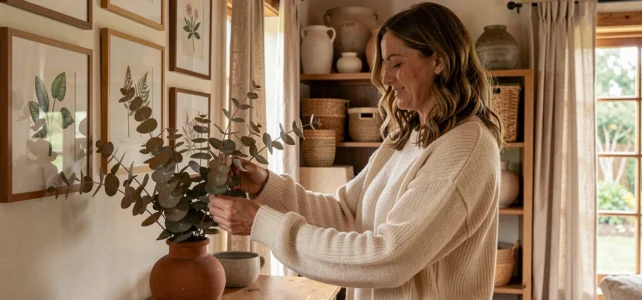
A room can be tastefully furnished and still feel cold. What transforms an interior into a warm home rarely depends on the budget: it’s a combination of materials, light, and decorative choices that create an enveloping atmosphere. Rather than listing recipes seen everywhere, this article explores three concrete levers, from color palettes to furniture shapes, to inject creativity into every room.
Earthy palette and warm colors: the foundation of an enveloping decor
Have you ever noticed that a pure white wall can give a clinical coldness, even in a well-furnished living room? The color of the walls and textiles sets the emotional climate of a room before any other element.
Recent trends confirm the rise of an earthy palette as a foundation for decoration: sandy beige, soft ochre, terracotta, cocoa brown, muted greens. These shades warm up a space without overwhelming it. Terracotta, in particular, has been gaining popularity for several seasons as an accent color for a living room or bedroom.
The principle is simple. Choose a warm neutral shade for large surfaces (walls, floor, sofa), then add one or two more pronounced accents through cushions, a painting, or decorative pots. An ochre wall paired with ecru linen textiles creates an immediate effect of softness, whereas a light gray wall would require many more accessories to compensate.
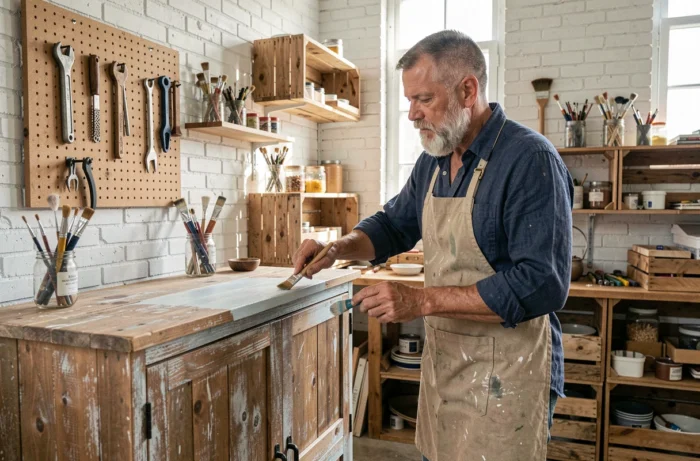
To delve deeper into applied decor ideas room by room, the home section on Les Bricoleries de Nanie details concrete projects, from furniture makeovers to entryway renovations.
Combining patterns without overloading
A warm interior gains character with patterns, but the trap is visual cacophony. A useful rule: limit yourself to two families of patterns per room. For example, a wide striped cushion and a subtle checked throw work well together because they share a different scale.
Keep the same color range between your patterns and your solid colors. If your sofa is a solid terracotta, a geometric patterned cushion in similar tones (rust, cream, brown) reinforces coherence instead of breaking it.
Soft architecture and rounded shapes: warming up without heavy work
The notion of soft architecture has emerged in recent years among interior designers. The concept relies on the introduction of rounded shapes, thick textiles, and softened surfaces to make rooms more enveloping.
In practical terms, this translates into accessible choices:
- A sofa with curved arms rather than an angular model. The difference in perceived comfort is clear, even at the same dimensions.
- A round or oval mirror in the entryway, which breaks the linearity of a narrow hallway.
- Fabric or rice paper light fixtures that diffuse light instead of projecting it in a harsh beam.
You don’t need to replace all your furniture. One or two elements with curved lines are enough to soften a room dominated by right angles. A round coffee table in a rectangular living room, for example, immediately changes the visual flow.
The role of thick textiles in the ambiance
A wool throw placed on an armrest is not just a style accessory. Dense-weight textiles (boucle wool, corduroy, thick linen) absorb some sounds and reduce reverberation. In a space with tile or polished concrete, this acoustic absorption makes the room feel significantly more intimate.
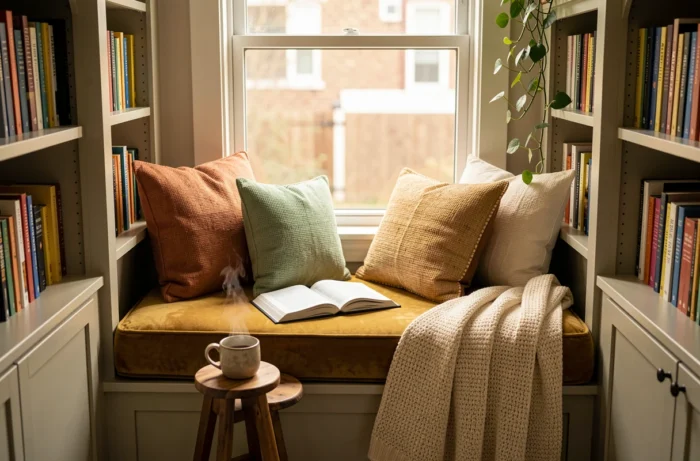
Velvet, in particular, captures light differently depending on the angle of view. A terracotta velvet cushion placed near a window changes hue throughout the day, adding movement to the decor effortlessly.
Biophilic design: integrating nature as a decor strategy
Adding green plants to a living room is classic advice. What is less understood is why it works beyond aesthetics. Biophilic design refers to a design approach that integrates natural light, plants, and organic materials to enhance comfort and indoor air quality.
Recent syntheses on the subject emphasize that this is not a passing trend but a comprehensive design strategy aimed at concentration, well-being, and better air quality. Applied at home, the principle unfolds in three axes:
- Increasing natural light. An opaque curtain replaced with a linen sheer lets in light while filtering views. The gain in brightness transforms the atmosphere of a north-facing room.
- Varying living materials. Raw wood, rattan, natural stone, terracotta: each organic material brings a texture that plastic or melamine cannot replicate.
- Arranging plants in layers. A large plant on the floor (ficus, monstera), a medium plant on a piece of furniture, a small one on a shelf. This layering mimics natural plant structure and adds depth to a corner of the room.
Wood as a common thread
Wood remains the most versatile material for warming up an interior. A solid oak shelf, a walnut table top, or simply a driftwood photo frame brings an immediate organic presence. The idea is not to dress everything in wood but to make it a subtle common thread that connects the rooms.
A detail often overlooked: light wood (birch, ash) visually cools a space, while medium to dark wood (smoked oak, walnut) warms it up. Choose the wood species based on the desired effect, not just the style of the furniture.
The difference between a simply decorated interior and one where you feel good often lies in these accumulated details: a coherent palette, a few curves among straight lines, materials that age well. None of these choices require heavy work or a significant budget, just a careful look at what each element truly brings to the living space.