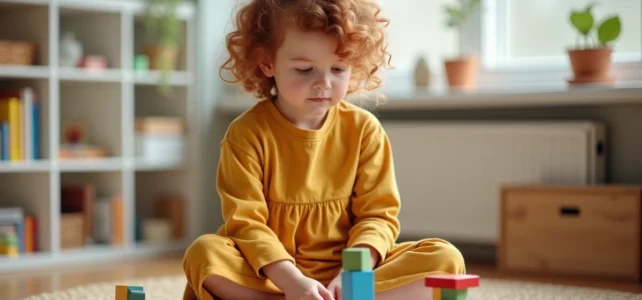
The awakening of a child is not limited to stacking educational toys on a shelf. It relies on the quality of sensory interactions, the regularity of daily micro-rituals, and the parents’ ability to observe what truly captures their child’s attention. Understanding these mechanisms allows simple actions to be transformed into concrete levers for development.
Sensory Wake-Up Ritual: Laying the Foundations for the Day from Morning
Since 2023-2024, early childhood professionals have formalized the concept of sensory wake-up ritual. The principle is based on a gradual and gentle stimulation of the senses at the moment of waking: dim light that gradually becomes brighter, calm sounds, familiar scents, and soothing physical contact.
The goal is to associate the morning with a pleasant experience rather than a constraint. A child abruptly pulled from sleep by harsh light and a demanding voice starts their day in a state of stress. A child who first perceives a soft voice, a hand on the shoulder, and gradual light begins to move at their own pace.
In practical terms, this can take the form of a small lavender diffuser activated a few minutes before waking, a nightlight that simulates dawn, or soft recurring music. The repetition of the same sensory sequence, day after day, creates an anchor that the child recognizes and that secures their transition from sleep to activity. Additional resources on the world of children on Maman Chic detail other approaches to structure these key moments of the day.
Mindfulness Adapted for Children: Concrete Self-Regulation Techniques
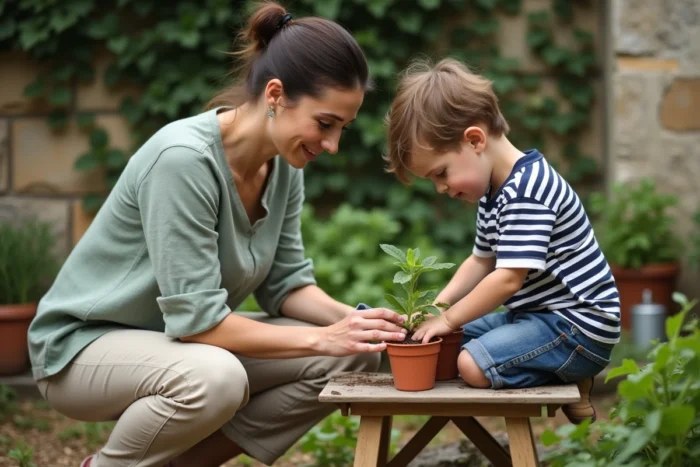
Mindfulness applied to children is no longer a niche for parents. Francophone school programs, particularly in Canada, now integrate structured self-regulation exercises starting from preschool. These exercises require no expensive materials and can be easily adapted at home.
The Five Senses Technique to Return to Calm
The exercise involves asking the child to name five things they see, four they touch, three they hear, two they smell, and one they taste. This sensory countdown refocuses attention on the present moment and interrupts the cycle of agitation or anxiety.
The effectiveness lies in its simplicity. There’s no need to explain meditation to a four-year-old. The counting game is enough to capture their attention and naturally slow their breathing rhythm.
Gesture-Guided Breathing
Breathing exercises work better when associated with movement. Asking a child to inflate an imaginary balloon with their hands while inhaling, then slowly deflate it while exhaling, produces a measurable effect on their tension level. The gestural component transforms an abstract instruction into a body game that the child takes ownership of.
- Blowing on a feather placed on their hand, trying to move it as slowly as possible, develops breath control.
- Placing a small lightweight object on their lying belly and watching it rise and fall with their breath makes the mechanism visible.
- Slowly tracing the outline of their hand with the finger of the other hand, inhaling on the rise and exhaling on the fall, associates touch with the breathing rhythm.
These techniques do not replace specialized support in cases of marked difficulty, but they offer parents a concrete repertoire of gestures usable in daily life.
Age-Appropriate Sensory Awakening Activities
A common mistake is to offer the same activity to an eight-month-old baby and a three-year-old child on the grounds that it is “sensory.” Sensory development follows a precise progression, and the activities must be adjusted accordingly.
Before Twelve Months: Focus on Touch and Oral Exploration
The baby discovers the world through their mouth and hands. Warm water play, fabrics of various textures, and objects of different sizes stimulate fine motor skills and tactile perception. Musical awakening, even in the form of simple percussion with everyday objects, activates listening and coordination.
From One to Three Years: Spatial Exploration and Sorting Games
At this age, the child begins to categorize. Color hunts in the house or garden, pouring games (transferring water, sand, seeds from one container to another), and playdough activities develop hand-eye coordination and learning about the physical properties of materials.
After Three Years: Cooperative Games and Storytelling
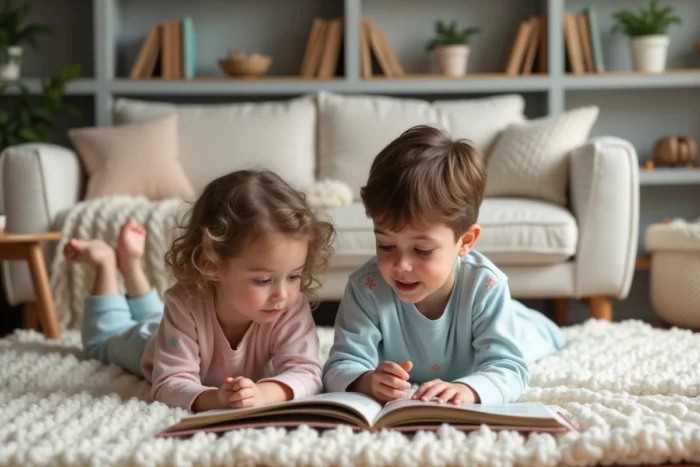
Cooperative play gradually replaces parallel play starting at three years old. Activities that involve a common goal (building a tower together, inventing a story with two voices, preparing a simple dish) develop language, the pedagogy of exchange, and emotional management.
- Cooperative board games (where all players win or lose together) avoid competitive frustration while teaching respect for rules.
- Collaborative drawing on a large shared sheet encourages the child to negotiate space and observe the work of others.
- Creating mini-shows (puppets, costumes) mobilizes memory, creativity, and speaking skills.
Everyday Environment and Well-Being: What Matters Beyond Activities
Structured activities represent only a part of awakening. The child’s permanent sensory environment plays a role as crucial as the games offered. The ambient noise level, brightness, organization of space at child height, and predictability of routines form a foundation of well-being upon which learning is built.
A child exposed to constant background noise (such as a television left on all the time) finds it harder to develop their selective listening ability. Reducing distracting sound sources during free play improves concentration without any material investment.
Creating a quiet corner, even reduced to a cushion and a few books in a corner of a room, provides the child with a spatial reference to refocus when stimulation becomes too strong. This approach aligns with practices observed in daycare centers that integrate voluntary withdrawal spaces for hypersensitive children.
The common thread remains consistency. A sensory ritual upon waking, breathing techniques integrated into the day’s transitions, age-appropriate activities, and controlled sound environments require neither a special budget nor expertise. They require observation and consistency, two resources that every parent can mobilize.