
The dominant taste profile in dining and snacking has shifted. The sweet-spicy combination, referred to as swicy by Datassential analysts, now structures product launches and street food menus globally. Understanding this sensory shift, along with other underlying movements reshaping culinary trends, requires moving beyond conventional discussions about local and plant-based foods.
Swicy profile and hot honey: the new grammar of taste in street food
Hot honey applied to pizzas, fried chicken, and burgers is no longer a curiosity. We are observing its generalization in fast food formats and industrial offerings, with variations like pineapple-habanero chips, maple-chili snacks, or spicy honey cereals.
What distinguishes swicy from a simple addition of chili is the intentional layering of two opposing registers. The sweetness rounds out the attack of the capsaicinoid, prolongs the mouthfeel, and creates an addictive recall effect that neither sweetness alone nor spiciness alone produces.
For formulation professionals, this means working with sugar/heat ratios with precision. A poorly balanced hot honey tips either into a mundane condiment or unnecessary aggression. The recipes that work best calibrate the spiciness in the background, with a peak of heat offset by a few seconds from the initial sweetness.
We recommend following the news from À Nos Petits Fourneaux to see how these combinations are expressed in home cooking and everyday recipes.
Fiber-enriched products: fibermaxxing enters pleasure formats
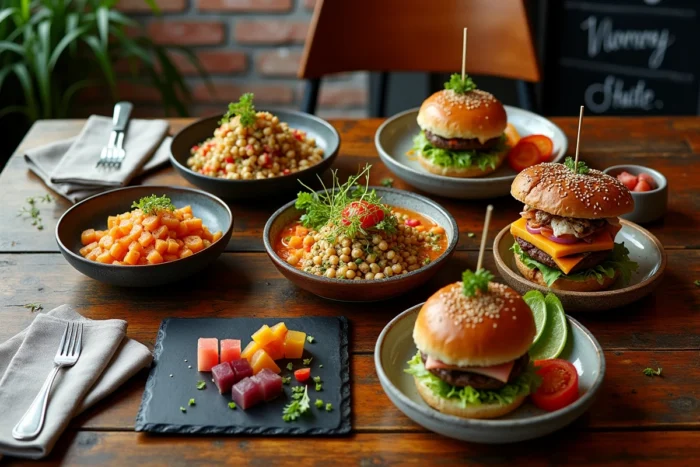
Fibermaxxing redefines the health-gourmet promise in 2026. Legumes, whole grains, seeds, and nuts are being integrated into categories that have never claimed fiber: ice creams, candies, sodas, chocolate bars.
The technical challenge is twofold. First, the texture: a dough enriched with chickpea or red lentil fibers alters the rheology, cooking behavior, and final chew. Second, the taste: some soluble fibers (inulin, beta-glucan) provide a roundness in the mouth that compensates for the reduction of fat, while insoluble fibers can generate a residual bitterness if poorly integrated.
For both industrial players and artisans, the addition of fibers is not just about nutritional enrichment. It alters the technical sheet of the finished product. Fiber-boosted pastas, for example, require adjustments in cooking time and hydration levels to avoid a sticky or grainy result.
Flame cooking and fermentation: ancient techniques, new demands
Michelin inspectors report a marked return of flame cooking in starred establishments. This resurgence is not a matter of nostalgia. It responds to a quest for deep Maillard reactions, irregular crusts, and smoky notes that are impossible to reproduce in a convection oven.
Working over an open flame imposes ventilation, safety, and consistency constraints that many professional kitchens had abandoned. We are seeing a reinvestment in dedicated equipment (Japanese robata grills, Argentine fire pits, Korean barbecues) and in training staff to manage live coals.
- The robata allows for fine control of the source-product distance, suitable for delicate fish and vegetables that require moderate radiant heat.
- The Argentine fire pit, with its adjustable height grill, is ideal for thick cuts of meat requiring long cooking at descending heat.
- The table Korean barbecue, integrated into the service, transforms cooking into a participatory experience and reduces the time between grill and plate.

On the fermentation side, the trend goes beyond kimchi and kombucha. Chefs are working with lactic fermentations on root vegetables ( Jerusalem artichoke, parsnip, celeriac) to develop plant-based umami profiles. Mushroom or pea garum, fermented for several months, is gradually replacing soy sauce in certain Nordic and French preparations.
Anti-inflammatory cuisine and new everyday dishes
The so-called anti-inflammatory cuisine is making its way onto restaurant menus and into mainstream recipes. It relies on a selection of ingredients recognized for their richness in polyphenols, omega-3s, and sulfur compounds: turmeric, ginger, berries, fatty fish, cruciferous vegetables.
The anti-inflammatory approach influences the very construction of dishes. Gentle cooking methods (steaming, low temperature) are favored to preserve micronutrients, and frying and added sugars are limited. This logic modifies the bases of sauces, stocks, and garnishes.
- Vegetable stocks partially replace veal or poultry stocks in binding sauces, reducing the fat load without sacrificing aromatic depth.
- Fresh grated turmeric, combined with black pepper to enhance the bioavailability of curcumin, is incorporated into dressings and marinades.
- Finishing oils are changing: camelina or hemp oil, rich in omega-3s, replace sunflower oil as a final touch.
This movement converges with the rise of Southeast Asian flavors in global gastronomy. Michelin inspectors note a new appreciation for the culinary traditions of this region, where fresh herbs (lemongrass, galangal, kaffir lime leaves) have played an empirical anti-inflammatory role for centuries.
The culinary world is undergoing a phase where nutritional performance and gustatory pleasure are no longer opposed. Fiber-enriched pleasure formats, homemade fermented condiments, and swicy profiles show that gourmet indulgence absorbs technical constraints instead of suffering from them. The coming months will reveal whether these movements solidify into sustainable standards or remain seasonal markers.