
The French cadastral plan is freely accessible online, but it does not reveal the name of a landowner. This confusion fuels massive searches on the subject. The site cadastre.gouv.fr allows you to visualize the boundaries of a plot, obtain its reference (section and number), and print an extract of the plan. Personal data, however, falls under a different administrative circuit.
To identify who owns a plot, you need to request a specific document: the cadastral matrix or property statement. This document is kept by the local land tax office (SDIF) of the concerned municipality and is partially accessible at the town hall. The free access depends on the channel used and the type of request.
Online cadastre and property data: what the plan does not show
The portal cadastre.gouv.fr and the platform cadastre.data.gouv.fr publish the geographical data of the cadastral plan: contours of plots, sections, buildings, cartographic layout. This data is open and reusable. However, the files of property owners are not part of the open data.
The distinction is rarely explained clearly. The cadastral plan identifies and locates a plot. It does not prove anything about ownership. The legal proof of ownership falls under the land publicity service, which keeps the registered notarial deeds.
Several online guides suggest that you can find the owner of a plot on the cadastre directly from the plan. This is technically inaccurate. The plan provides the cadastral reference (for example, section AB, plot 123), which then serves as a key to query the relevant services.

Free request at the town hall or SDIF: conditions and real limits
Two offices allow you to obtain information about the owner of a plot for free: the town hall and the local land tax office.
What the town hall can communicate
Town halls have a partial copy of the cadastral matrix. An individual can go there and request the name of the owner of a plot identified by its cadastral reference. This process is free.
The town hall generally only communicates the name of the owner and the designation of the plot. It does not provide the entire property statement (list of all properties owned by a taxpayer in the municipality). Access at the town hall remains the most direct free channel for a one-time search.
What the SDIF can provide
The local land tax office (SDIF) holds the complete cadastral matrix. It can issue an extract of the matrix, which lists all the plots and built properties owned by an owner in the municipality. This document is more comprehensive than what the town hall provides.
The request can be made by mail, email, or in person. It is free. The requester must provide the cadastral reference of the concerned plot, obtained beforehand on cadastre.gouv.fr.
When the administration requires a legitimate interest
The point that most guides omit concerns the nature of the request. To obtain information about one’s own properties, no justification is necessary. For information regarding a third party’s property, the administration may require proof of a legitimate interest.
Situations generally accepted without difficulty include:
- Searching for the owner of an adjoining land as part of a boundary or co-ownership project
- Identifying the holder of a plot for acquisition purposes when the property is not listed for sale
- Verifying a property boundary to resolve a dispute between neighbors
Requests motivated by mere curiosity or by a commercial approach (real estate prospecting, for example) may be denied. Field reports vary on this point: some SDIFs respond without asking questions, while others request a written justification.
Land publicity service: the official document that proves ownership
The cadastre has never constituted legal proof of ownership. The document that serves as proof is the mortgage statement (or property sheet), issued by the land publicity service (formerly the mortgage registry).
This document outlines the history of a property’s transfers: successive sales, donations, ongoing mortgages. It allows for the current owner to be identified with certainty and verifies the existence of encumbrances on the property.
The request is made via a Cerfa form or by mail addressed to the competent land publicity service (the one for the location of the property). This service is not free: issuing a mortgage statement incurs a property security contribution.
Resorting to the land publicity service becomes essential in several cases:
- When the SDIF or town hall cannot respond (plot located in a municipality where cadastral data is incomplete or outdated)
- When the request concerns the history of ownership and not just the current owner
- When an authentic deed is necessary for a legal procedure (inheritance, expropriation, easement)
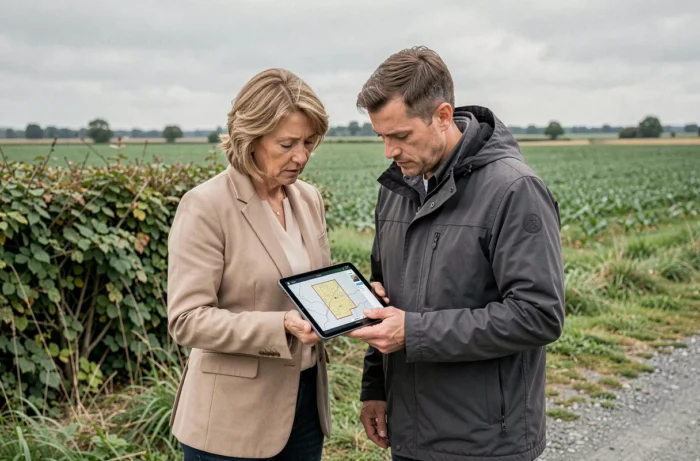
Cadastral reference: the prerequisite without which no search succeeds
All the steps described rely on the same starting point: the cadastral reference of the plot (municipality, section prefix, section, plot number). Without this reference, neither the town hall, nor the SDIF, nor the land publicity service can process a request.
On cadastre.gouv.fr, the search is done by address or by location on the map. A click on the plot displays its reference. This step is entirely free and does not require any registration.
Third-party platforms like Géofoncier or France Cadastre offer alternative interfaces to access the same references. Some charge for additional services (matrix extraction, sending pre-filled forms). The official cadastral plan remains accessible free of charge on the State portal.
The total free access to the process stops at two steps: consulting the plan online to obtain the reference, then querying the town hall or SDIF to find out the owner’s name. As soon as an official document is required, going through the land publicity service incurs a cost.
Confusing these three levels of information risks leading to the belief that a simple click on a map is sufficient to answer a question that falls, depending on the case, under administrative or civil law.